A Fine Romance Friday: The Cutting Edge

So a giant blizzard is about to bury the east coast, specifically Washington, DC. Well, if you’re looking for something steamy set in the Capitol, I have some ideas. You can’t read all the time–okay, you can, but you might not want to–so what should you watch between books and cocoa?

The clear answer is Paul Michael Glaser’s romantic comedy The Cutting Edge (1992).

If somehow you haven’t seen it, it’s essentially an updated version of The Taming of the Shrew set against the backdrop of pairs figure skating. Our shrew is Kate (Moira Kelly), a spoiled and notoriously difficult skater who lost her latest partner 18 months before the Olympics. She needs a new one or else she won’t be able to make a play for the medal she came so close to winning the last time. The only problem is that no one will skate with her.

Enter our Petruchio, Doug (DB Sweeney), a hockey player whose career was cut short by an injury. Skating with Kate not only brings him a healthy paycheck by way of her wealthy dad but is also his last shot to get of his dead-end job at his brother’s bar.

What follows is completely predictably and utterly charming. Kate and Doug are enemies, then they’re friends, and finally lovers, all the while trying to perfect an impossible skating move.

It’s the rare winter romance that comes with scarcely any holiday trimmings (they exchange Christmas gifts and there’s a brief New Year’s scene). But more seriously, I would argue that it’s the first New Adult romance, and it may still be the most influential entry. It includes, fully formed, most of the tropes we still see in the subgenre, including the protagonists’ tragic backstory (Kate’s mother’s death, Doug’s injury), drama with the parents/the struggle for independence, banter, tension, angst, and sports.

The Cutting Edge just about the perfect movie for a snowpocalypse–anytime of year.

Happy Birthday to Party Lines!


design (32)

Authors probably aren’t supposed to have favorites among their books. I mean, I assume. I’m not very good at authoring. But today is the book birthday of Party Lines. Among the contemporary romances I’ve published…it’s my favorite. (Though the book I’m writing now is giving me major feels.)

To celebrate, I put together some text/image things with some of the best lines. You can see them all on the book’s Pinterest board.

I hope Lydia and Michael are celebrating with banter and bourbon!

Tenant of Wildfell Hall, Vol. 3

We had our final discussion of Anne Bronte’s The Tenant of Wildfell Hall last night, and it was so fun! You can read the entire thing by looking at the hashtag #TOWH, but the topics covered included:

  • Why don’t we get much of Helen’s POV after she leaves Huntingdon? She sends letters to Frederick, but they’re not very psychologically revealing. Is Bronte saying that women’s voices disappear when they fall in love?
  • What similarities are there between Hartley and Gilbert? (They both seem confused by no, they both seek to exploit Helen’s vulnerabilities, they even use identical arguments re: her (illegitimate) marriage to make their propositions.) Is the only difference between them that Helen is receptive to Gilbert’s advances?
  • Was there chemistry/affection between Helen/Huntingdon (prior to their marriage) and, later, Helen/Gilbert? Cat smartly argued that the book only works if you assume off-the-charts levels of attraction, and I agree.
  • Related, do we buy Helen and Gilbert’s happily ever after? Is it a conservative end to Helen’s otherwise proto-feminist story? Is it necessary for her to marry again to provide a father for Arthur?
  • Should Toby Stephens star in every Bronte film/television adaptation? (Yes.)
  • Why did every damn character have an H in his/her name?
  • Why was there so much plot (and out-of-character behavior) in volume 3, when volume 2 had been relatively staid? (Also, I looked it up and Tenant wasn’t serialized first, so I don’t think that explains all the craziness in volume 3.)
  • What was up with Lawrence and Esther’s seemingly abrupt marriage? Did Helen attend? Why didn’t Lawrence’s servants know he was getting married? Etc.

We also talked a lot about what if anything to read next. There seems to be enough enthusiasm for me to say yes we should schedule another read along. I was thinking March to give us time to recover.

The general consensus seems to be to do another “classic,” and one that would be of interest to romance readers (though not necessarily one with a happily ever after). Here are a few of the suggestions:

  1. George Eliot’s Adam Bede (1859): the blurb on this sounds insane in the best way. It’s a seduction novel wrapped in a murder plot and includes independent women, women preaching, and out of wedlock birth. The downside? It’s 500 pages. If we’re going to commit to a huge Eliot novel, should we just say screw it and go with Middlemarch (my edition of which is 800 pages)?
  2. Helen Webster Foster’s The Coquette (1797): it’s an early American epistolary seduction novel, and essentially a right suitor/wrong suitor book that touches on what women achieved in the American revolution and what should happen to fallen women. It comes with a bonus (maybe) appearance by Aaron Burr as one of the suitors. The end is definitely a downer, but it’s only 160 pages.
  3. George Gissing’s The Odd Women (1892): this sounds fascinating. It’s a double romance set in the late Victorian period and includes meditations on independent women and love in the lower classes. It’s 370 pages.

I would happily read any of these books, or whatever else people might be up for. The poll that I set up on Twitter last night ended up as a three-way tie. So let me know in the comments/via email/on Twitter/through a carrier pigeon what you’d like to do.

Thank you so much for joining us, and I’m looking forward to round two!

2015 in Review

IMG_20160101_132329

Let’s do this again! In 2015,

  • I released Party Lines, a book I’m fiercely proud of;
  • Gen and I finished writing Star Dust, plus we edited and released it;
  • Gen and I wrote, edited, and released A Midnight Clear;
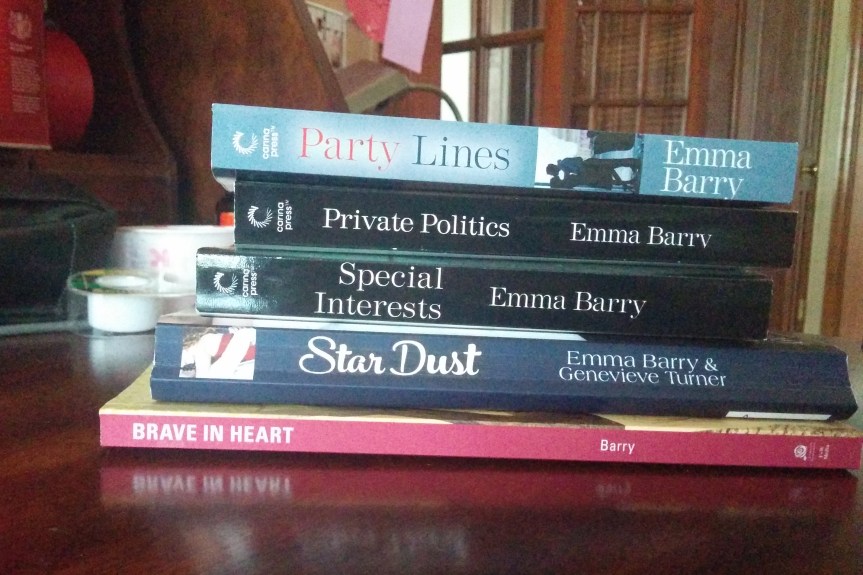
  • I got the rights back for Brave in Heart;
  • I finished a novella in The Easy Part series, though whether I’ll publish it is unclear;
  • I wrote 20K on a standalone novella (and I may have figured out what to do with it!);
  • Gen and I wrote a good chunk of Earth Bound; and
  • I wrote a good chunk of two other books, each of which would kick-off a new contemporary series.

My total words written this year is again in the 100K-range, which isn’t where I’d like for it to be, so I need to get that side of things in gear. I also read 50ish new-to-me books (plus I did a lot of comfort re-reading).

My goal for next year is to publish (or republish) four projects, to query agents with the contemporary romance I’m writing, and to work more consistently and happily and with less self-consciousness.

I’m wishing you, dear reader, a happy and healthy 2016.

Tenant of Wildfell Hall, Vol. 2

This week in our discussion of volume 2, we got Helen’s point-of-view and chewed on questions like:

  • Huntingdon: a big jerk or the biggest jerk?
  • Huntingdon as Branwell stand-in (you’ll have to ask Gen for the details on this).
  • How bad/immoral were the other men in this section (e.g., Hattersley, Hargrave, etc.)? Was Huntingdon leading them astray or were they evil on their own? And if they were all bad, is the novel misandrist? Is it saying Helen had no good choices? Is its central wisdom that once a woman saddles herself to a jerk–and particularly has kids with him–she has no good options?
  • For as bad as Huntingdon is, he isn’t physically violent toward Helen; his abuse is psychological. Why did Bronte frame him in this way?
  • How does volume 2 make you see volume 1 differently (e.g., the town’s meddling in Helen’s parenting)?
  • Is Tenant feminist? Can we project a modern term/concept back in time on a mid-19th century book? And does Tenant have anything to offer us as 21st century feminists?

There was also a long side discussion about the novel’s form. Volume 1 is epistolary, though since we never (or at least haven’t so far) met Halford, the conceit is a bit thin. Volume 2 is presented as series of diary entries. There are loads of 18th and 19th century epistolary novels, but there are fewer diary (or at least all diary examples). Go Ask Alice, Bridget Jones’s Diary, and “The Yellow Wall-paper” (ETA: oh, and the Adrian Mole series by Sue Townsend) were the only ones we could come up with. I’m curious to see what will happen with the narrative in volume 3.

We also talked about whether to do another read-along. I’m a big fan of obscure 18th/19th century American novels, like Fanny Fern’s Ruth Hall, EDEN Southworth’s The Hidden Hand, or Hannah Webster Foster’s The Coquette, but I’d also be happy to stick with European proto-romances–and I would definitely be on-board for a session on Balzac’s Cousin Bette, which I think is under appreciated.  There was also a suggestion to read Edith Wharton (I’m always up for Wharton!) or maybe even some early romances like The Flame and the Flower.

So is there an audience for another read-along? If so, what and when? Let me know in the comments or on Twitter. And join us next week for our final discussion of Tenant volume 3!

Tenant of Wildfell Hall, Vol. 1

We had our Twitter discussion of volume 1 of The Tenant of Wildfell Hall last night. We covered ground like

  • the preface (would it be seen as too confrontational in today’s writing environment?),
  • similarities to/deviations from Austen (e.g., Reverend Milward),
  • the framing device,
  • Gilbert (prig or flawed hero? why does he hit Lawrence? does that make G irredeemable?),
  • the meddling of the villagers,
  • Gilbert as a stand-in for Branwell Bronte,
  • the many negative male characters,
  • the female characters as different reactions to social limits,
  • Helen’s art as metaphor,
  • and various literary references in the text.

It was a fast-paced discussion and a lot of fun. But I know that not everyone is on Twitter, the time wasn’t convenient for everyone, and of course the 140-character limit can constrain discussion. So what thought do you have on volume 1? What are you looking forward to in volumes 2 and 3?

Seven Days of 60s Food: Butter Crispies

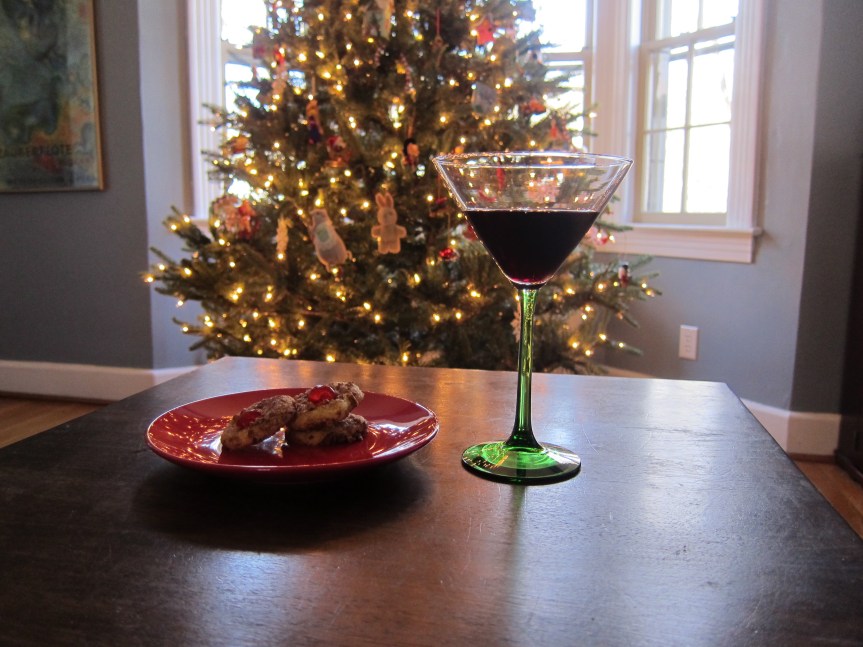
Those heady of 60s food posts are over…except, well, they’re not. Today, we have my favorite Christmas cookies: butter crispies. This is a recipe given to me by my grandmother, and it’s sure to put a retro twist on your holiday baking.

plate of cookies, cocktail, and Christmas tree

Continue reading “Seven Days of 60s Food: Butter Crispies” →

The Tenant of Wildfell Hall Read Along!

picture of books on shelves, including several titles by the Brontes and Jane Austen

For several years, my critique partner/co-writer Genevieve Turner has been trying to get me to read Anne Bronte’s The Tenant of Wildfell Hall (1848). “It’s a feminist novel with a kickass heroine,” she’s argued. “You’ll like it.” Every time I’d mention some obscure nineteenth-century American novel with a subversive heroine, she’d say, “But in Tenant of Wildfell Hall, something even more shocking happens.”

And I…have been stubbornly refusing, or–if not refusing–avoiding. I like Jane Erye a lot; you may remember my theory that while Jane Austen gave romance a parcel of plots, the Bronte sisters gave the contemporary genre a style. (I’ve actually written about Austen, see also this.) But I’m a bit lukewarm on the Brontes I’ve read other than Jane Eyre.

However, loving Gen as I do, I’m going to trust her and avoid Tenant no longer. You’re cordially invited to a read-along. Bronte fangirls on their tenth re-read (like Gen) are welcome; so are newbies (like me)! The book is divided into three volumes. Our plan is to discuss Vol. 1 on Twitter on December 21 at 9 PM EST/6 PM PST using the hashtag #TOWH. We’ll tackle Vol. 2 at the same time on December 28 and Vol. 3 on the evening of January 4.

If you want to join us, the free e-book is available at Amazon, iBooks, B&N, Google Play, Kobo, and Project Gutenberg and you can add it to your Goodreads shelves. I hope to see you there!

PS Speaking of things to read, A Midnight Clear is still out, still free, and still adorable. It’s one of the titles in today’s holiday-themed Stuff Your Kindle event; check out the rest here!

Las Morenas Giveaway!

512+-duLKtL._SX310_BO1,204,203,200_

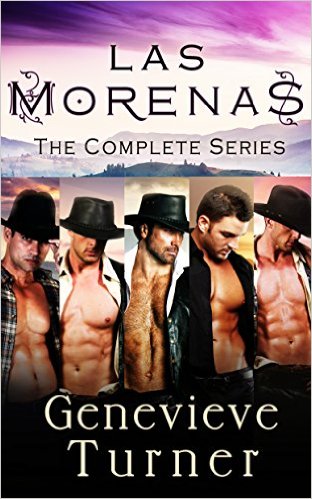
I normally keep this a bit of secret, but I do have an author Facebook page. And over there, I’m giving away a copy of Genevieve Turner’s just-released Las Morenas series box set. One, are those hot covers or what? But, two, the books themselves are even better: romantic, intricate, engrossing, and diverse. I love them all.

So stop by and comment if you want to win! And if you just can’t wait–who could?–you can buy a copy at Amazon, iBooks, B&N, Google Play, and Kobo.

Reflection

I cried last night about Paris, about Beirut, about a shooting near the campus I teach at. There’s more than enough senseless violence in the world to break your heart today and for the rest of the week. For the rest of your life. I cried for the victims, and I cried for their families, and I cried for all of us falling asleep with more fear in our hearts than we’d had there in the morning.

In the middle of the night, my son had a nightmare. I was grateful–not, of course, for his worries, but that I could get into bed with him and smell his hair. That I could feel his lungs fill and empty, listen to the dub-Dub of his heart, and soak up the evidence that he, that I, were alive.

Fiction immerses the reader into someone else’s point-of-view. It permits us to share intimately someone’s joys and fears and hopes. As readers we take on a different set of skin with every book we open. And as writers we push past our own experiences to imagine other ways of being in the world.

I don’t know much, but I know that we share a common humanity. I know that mine is enriched by recognizing yours. I know that love is transformative and the world needs more of it. Whenever I’m tempted to turn away from the world, what I need is more love and empathy. Those, and not hate, are the roots of my humanity, and words can nurture it.