Thoughts on Online Book Discussion

I keep writing and deleting this post. No one needs my thoughts on this matter; no one asked for them. Others have explored this topic much more elegantly and insightfully (see here, and here, and here, and here). This is little and it is late. But I can’t leave this unsaid.

Talking about books is the most important part of my intellectual life. When I was a freshmen in college, I was an English major, but considering changing to classical archeology (true story). Then I stumbled into the first half of the American literature survey. It was as if I had landed on a planet with more gravity. Everything shifted and settled around me; everything changed.

In that class, I found people talking about books in the way I did in my head except they did it out loud. And they did it better than I did: more insightfully, with connections to texts I’d never heard of, respecting theories I didn’t understand. So I kept taking English classes. I studied British literature and Irish literature and literature in translation. I analyzed contemporary popular culture and critical theory and linguistics. I wrote about Austen and Shakespeare and Marx. I fell in love with New Historicism. But thanks to that first college literature course, early American book culture stayed central in my heart.

For a while after college I did redacted things in Washington, but I missed books. I missed talking about books. So I went to graduate school to get back the feeling I got from the literature classroom. And now I do it all day.

When I started reading romance almost four years ago, the reason I kept doing it wasn’t how romance did deeply imaginative things related to gender norms and sexuality (though also that), it was the book culture I found online. Here were people talking about books in way I did at the university except without all the things that can come with academics–some of which had become loathsome to me. The online romance discussion seemed more radical, more subversive, and more democratic than what was happening in my university classroom.

I don’t think it’s an exaggeration to say that I felt like I could start writing because of the online romance community. The academic world routinely makes me feel stupid and disempowered, but romancelandia does the opposite. The book culture around romance gave me permission to use my voice in a way I’m not certain I would have otherwise.

I don’t think this is about Kathleen Hale anymore. Not really. It’s about the fact that the book culture online has stopped feeling fun. Since I’m now writing and have a vested (albeit tiny) commercial interest in that culture and since I don’t review (related to my author role), I’ve mostly seen this from the sidelines. But the hype machine and its relation to book blogging seems qualitatively different today than it did 3.5 years ago when I started reading book blogs.

I have no solutions here, but it breaks my heart. Because every time I read a good book, I feel less alone. I feel more connected. I feel human and giddy and alive. And online book culture at its best networks those private reactions and feelings. Amplifies them. And it can be awesome.

I don’t know how to preserve it. And to the extent that my author activities may have taken away from anyone’s fun or just contributed to the blurring of public (in the Habermasian sense) and commercial spaces, I am sorry. Because if there’s no joy in talking about books, I don’t know what else we’re doing or why else we’d be doing it.

A Completely Biased Recommendation

Two years ago I had finished my drawer novel and Brave in Heart and had started writing Special Interests. I’d been telling stories in my head since forever, but I’d only been writing them down for about a year. But it turned out putting my ideas on paper was both harder and funner than my vague imaginings. And indeed I had realized I wanted to try and publish. So I decided to find a critique partner to help me become better at the writing part.

The process is sort of like online dating. You craft a profile, stress about it, and delete everything you’ve written. Then you rewrite the notice without the puns and close your eyes as you post it on different writer’s message boards and listservs. When you finally hear back from someone and parse her profile, you exchange chapters. You send notes, read the feedback, and ask yourself if you want to spend months reading this person’s work.

During the weeks I searched for a CP, I read a lot of good chapters and met several interesting people. But the only one I made it to the second-date stage with was Genevieve Turner. And her first book came out today.

Summer Chaparral Cover

I can’t be objective about this book; let the record show that I’m admitting that up front. I’ve read it many times and it’s a palimpsest for me. When I read Summer Chaparral, I see the book it was and the book it’s become and I filter it through Gen’s and my now long-standing partnership and friendship.

But let me tell you why I wanted to keep reading it during our “first date” and why I think you should too.

Summer Chaparral is a Romeo and Juliet tale about an American cowboy named Jace–seriously, the name gives me shivers–and Catarina, the eldest daughter of a Californio family. I’m a heroine-centric reader and Catarina was the hook for me. The closest cognate to her is Scarlett O’Hara, but I hesitate to say this because Gone With the Wind makes me stabby (I talked about that novel at some length here). She’s not beautiful and kind and self-effacing and delusional about her charms as some romance heroines are. She’s pretty and she’s knows it–but it hasn’t made her happy at all. She wants things. Little, normal things in her world, a home of her own and a family and a small measure of domestic power, but she hasn’t achieved them.

Jace wants things too. Like Catarina, the things he wants are small: his own ranch, a life that’s measured on his own (vs. his family’s) terms. And this beautiful, intriguing woman can help him get them. It all seems easy enough, but quite unbeknownst to them (except maybe not at all unbeknownst), they’re playing roles in old family and cultural dramas.

It’s a shot-gun marriage story, in which desire isn’t convenient and doesn’t solve the problems. But what happens after the marriage, and how this one couple must solve personal and sociocultural hurts, is what’s really fascinating.

It’s a story that’s deeply inflected by setting. Beyond Catarina, I wanted to keep reading because Gen is a beautiful writer of place. Her descriptions of the town of Cabrillo are breathtakingly specific and lovely. So between the vain but vulnerable heroine and the nature writing, I signed up for more. I’m really glad I did.

Again, this isn’t a review. I cannot fairly or objectively review this book and I want to support the Blogger Blackout. (Look at me, contradicting myself like a boss.) But, all that being said, if you like “unusual” historicals or spicy historical romance or Western romance or just plain old good books, I think you should check it out on Goodreads or Gen’s website or you can buy it Amazon, B&NiBooks, Kobo, and All Romance.

Book-Ends

(This is the latest in a series I’ve been writing about how we read, why we read, and what we read. It’s, um, a bit ponderous. These things happen.)

Over at Dear Author today, Janet writes about how the specialness of books should be determined by readers:

If anyone should be deciding whether books are special, it should be readers. No, let me correct that. Anyone can believe that books are special. Authors, publishers, editors, cover artists, marketing advocates – whoever. But the only people who should be deciding for readers if and when and which books are special, are readers.

I agree with this whole-heartedly, as I do with most of the piece. Books are consumer goods whose use value is determined by the reader. Their worth isn’t intrinsic. While gatekeepers like marketers, reviewers, booksellers, teachers, academics, and other readers influence these determinations–insofar they shape our taste and teach us how to read/make meaning from texts at all–it is ultimately the individual with the book on her couch or on the subway who decides if Moby-Dick was worth the slog.

To the extent that anything separates books from other consumer goods, it is that books in their physical or digital form are unfinished. We must decode them. And I do think that the reading experience provides a more intimate communion with books than consumption does with many other consumers goods. When I read, I have a reading voice in my head that repeats every word (or every few words if I’m skimming). I literally re-articulate everything the writer transcribed (and which editors, formatters, etc. shaped) and then filter it through my education, my past reading experiences, my mood, and so on in order to decide what it means. This is a somewhat different experience than eating an apple, wearing a shirt, or even looking at a picture.

I don’t think that my Moby-Dick is necessarily your Moby-Dick. And my Moby-Dick isn’t the same as when I first read the novel seven years ago. Today’s would be shaped by the first and the subsequent reading experiences. A rose is a rose is a rose: the first rose isn’t the last.

We must “finish” other consumer goods, of course, either by assembling them (e.g., Ikea furniture), making things out of them (e.g., groceries), etc., and we do have to decode other cultural goods, like film, music, and television, but books have always seemed different to me both because I value them more but also because the process takes longer. I’m a fast reader, but it still takes me four to eight hours to read a 70,000-100,000 word novel. I’m going to spend a lot of time with the writer (and the editor, etc.) in my head. And the form in which I’m going to experience a book is closely aligned with the form in which it was produced. A writer wrote on a page and I’m looking at a page, or a screen as the case may be. This may give books a sort of…liveness that other cultural productions don’t have. (I’m not sure what to call this quality.)

So books aren’t special but they are participatory in a way that marks them among consumer goods.

Continue reading “Book-Ends”

A Fine Romance Friday: Roxanne

I haven’t done a film post in forever! So let’s rectify that with Fred Schepisi’s 1987 rom-com Roxanne. The movie updates the nineteenth-century play Cyrano de Bergerac and stars Steve Martin as a small town fire chief in love with a beautiful astronomer (Daryl Hannah). He assumes she’d never go for a guy like him–namely one with an epic nose. And so when he discovers her crush on the handsome but shallow Rick Rossovich, he gives that guy the right words to succeed with her, saying all the things he wishes he could but doesn’t dare through a handsome mask. Hijinks ensue and the source material is updated with a happy ending.

Roxanne is pretty darn charming. It uses its small town Colorado setting to great advantage, has an excellent supporting cast (led by Shelley Duvall and Fred Willard), and is funny–particularly the self-deprecating exchange in which Martin comes up with twenty creative insults for his own nose and the ear-flap hat/feeding of the lines scenes. In another moment, Martin convinces a group of women to go to Roxanne’s house looking for aliens in order to interrupt a liaison he made happen; his imitations of the aliens with suckers on their hands and feet is a standard joke in my family.

But beyond the obvious humor, I like the film’s quieter moments: the ways in which Martin conveys his character’s vulnerabilities and fears beyond his public persona. The film laughs at his large nose, but it also shows us the shadow of real emotion under the jokes. Plus, the letters Martin writes Hannah are quite romantic.

It’s not ground-breaking and further it’s imperfect. I’m always frustrated that Hannah falls for the ruse. She’s supposed to be smart for crying out loud! But she does get to voice why Martin’s actions were stupid in the last act and he does a good grovel. Plus the film doesn’t engage in any slut shaming for her sleeping with Rossovich unlike another some other films from the same period like The Money Pit.

But despite its imperfections, it’s a great choice for an early autumn Friday, when the sky’s still clear enough to look for comets. On such a Friday, I commend Roxanne to you.

Cover Reveal: Party Lines

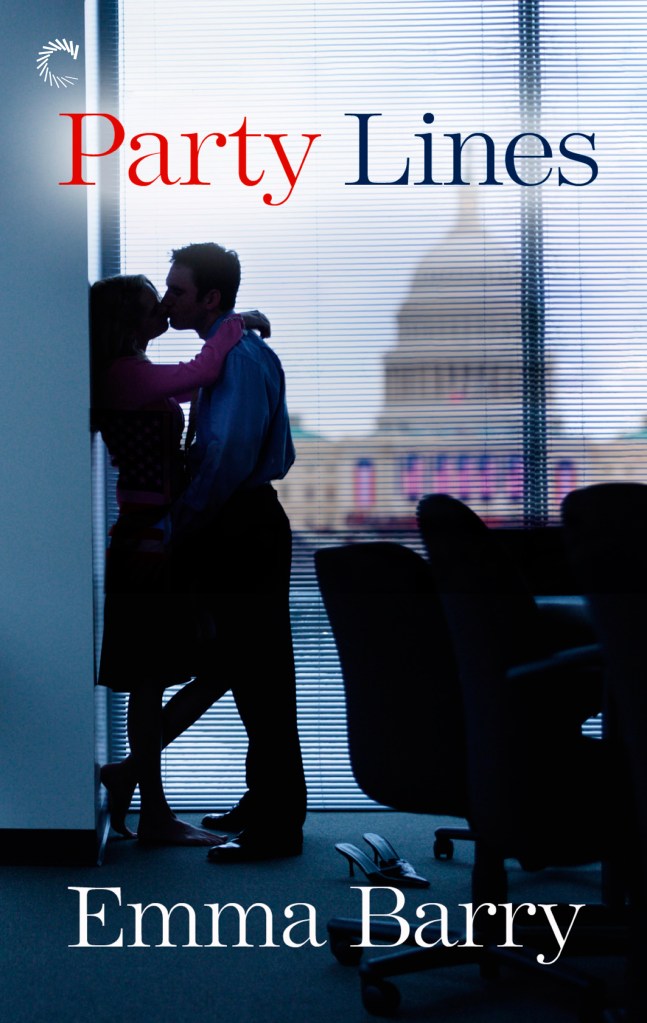
I considered doing a cover reveal, or sitting on this until my own exhaustion from Private Politics’ release faded, but I’m crap at keeping secrets. So here’s something pretty for your Monday: the cover for Party Lines.

Party Lines Cover

Gorgeous, right? I think it’s my favorite cover for the series.

I don’t have a full blurb yet, but here’s the log line: “As a presidential campaign rages, and a reckless affair becomes a relationship, a cynical Democrat and an ambitious Republican will have to choose between party loyalty and their hearts.”

You have a wait four whole months for the book to be out, but it’s already available for presale at AmazonB&NKobo, and Google Play with more venues to follow soon. You can also add it to your Goodreads shelves.

We Get to Carry Each Other

Last week the Irish band U2 did a terrible thing. They released a previously unannounced album and Apple automatically put it into everyone’s iTunes accounts–for free.

I know, right? Those jerks.

I’m mostly joking; I did find the situation creepy. Let me decide if I want your music. If I don’t, let me delete it. And at least as serious as the presumption and privacy violation, as I started listening to the new album, all I heard was over-produced, generic pop. Like most of their recent efforts, this album lacked verve and originality. The band’s fingerprints, even. After a few spins, I think I’m out.

Songs of Innocence did, however, spark an intense discussion about the group and their place in popular culture, including a fascinating New Yorker article by Joshua Rothman on “The Church of U2.” (Aside: I was discussing the piece with my friend Kimberly Truesdale, she pointed toward some pieces she’d written about the same themes a decade ago, including this one. Very smart stuff.)

In the process of reading these essays I started listening to the U2 music I actually like including their masterpiece “One.” In the chorus, the speaker sings, “We get to carry each other.” And today, the emphasis in the line sounds to me as if it’s on the word “get.” As in we have the opportunity to carry each other. The responsibility. The reward. The expectation. All of these things, good and bad at once, come from being subject to one another.

I have inconsistent work habits to put it mildly. I’ve written 7,000 words in a day, but most days I write none. I cannot defend this. It is not good process. I know it, and yet I persist in doing it. I think about my projects all the time, but they occupy my fingers less. I don’t think of it as the muse leaving the building. It’s more like a tide. At periods, it will be in and my brain is fecund. Then it rolls out and I’m like a shell baking on an arid shore.

Or like a vessel. I pour myself out, trusting that it will refill. And right now, I’m waiting.

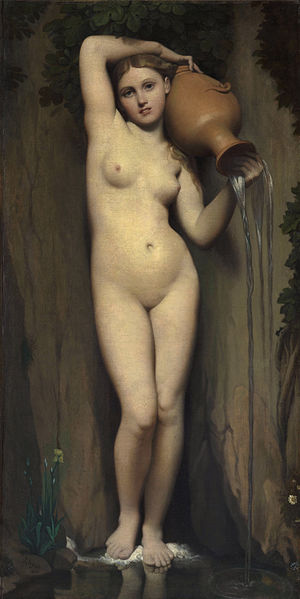
La Source, Ingres Image Used via WikiMedia Commons License
La Source, Ingres
Image Used via WikiMedia Commons License

Continue reading “We Get to Carry Each Other”

A Tale of Five Opening Sentences

Until Party Lines (which will be out in January!), I had never written an opening chapter that remained in the final version of the manuscript–and I don’t mean that I made a few minor revisions to the writing. In every manuscript until Party Lines, I had dumped at least one chapter and significantly changed how I introduced the characters and the conflict. I previously shared with you the original opening chapter of Brave in Heart (compared to its actual opening chapter) and I could do the same for Special Interests as well as for my drawer novel.

In the case of Private Politics (which released yesterday! woo-hoo), I ran through five different openings. That’s right: five. There were three entirely different concepts and then, when I’d found the right one, I tweaked it until I got the first paragraph right. The reasons why the first four didn’t appear in the book varied. But let’s catalogue them!

(Warning: there are very minor spoilers for Special Interests in here. There are also references to the premise of Private Politics. If you’ve read the blurb, none of this will surprise you/ruin the book for you, but if you like to experience books without any information whatever about the premise, don’t read this post.)

Continue reading “A Tale of Five Opening Sentences”

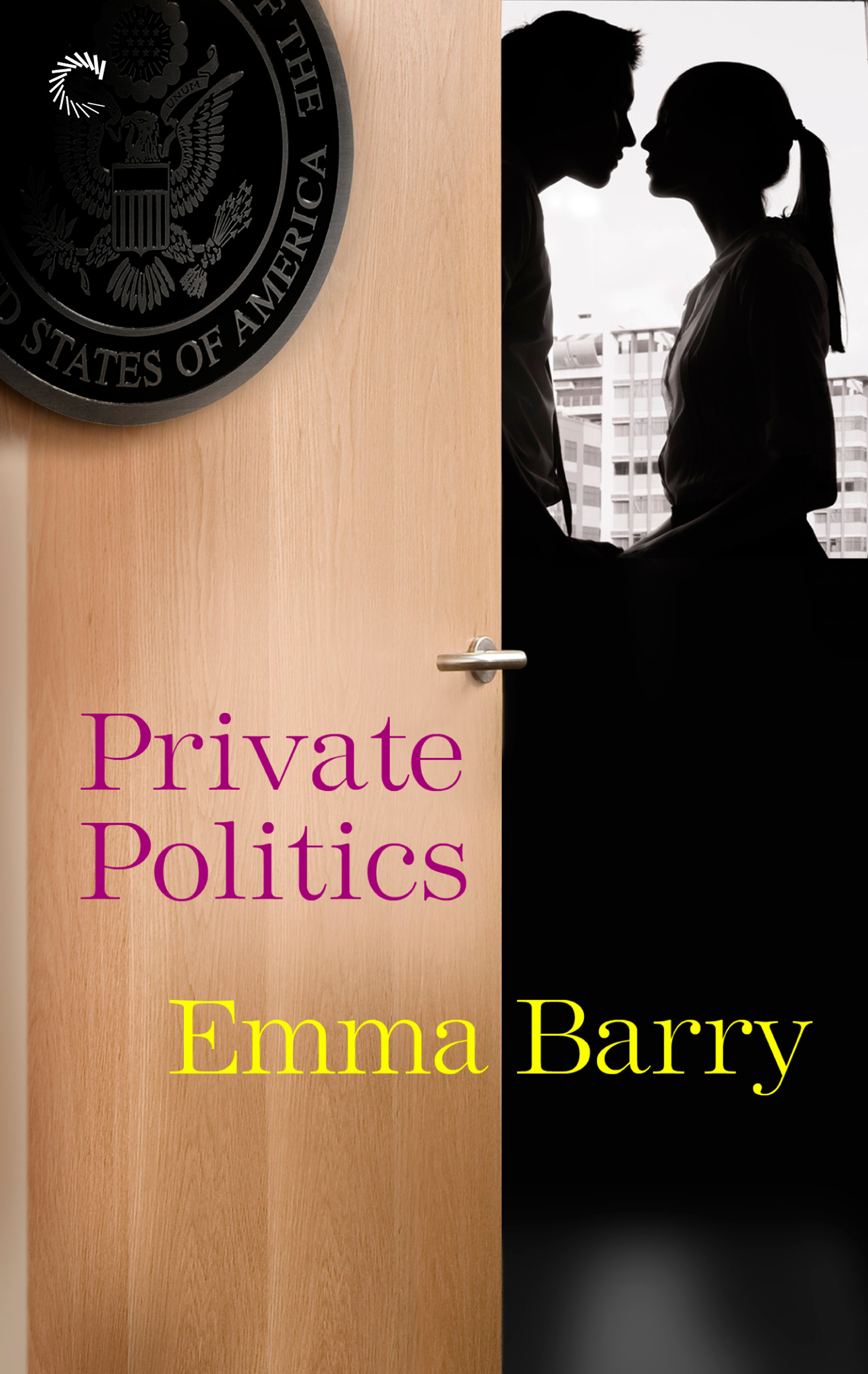
Private Politics Release Day

A year ago, I was finishing the first draft of a book. A book about a snuggly blogger hero and the socialite fundraiser he loves from afar. About a scandal and money and influence. About finding yourself and shattering others’ expectations. And about shoes–lots of shoes.

Private Politics Cover

That book, Private Politics, is now out! And you can buy it at cool places like AmazonB&NCarinaiBooksKoboAll Romance, and Google Play or add it to your Goodreads shelves.

I had to write Special Interests, the first book in the series. Millie and Parker wouldn’t leave me alone. Writing was an attempt to excise them from my head. That translated into the intense chemistry between the characters.

Alyse and Liam were different. Writing their book was scarier because my publisher had bought it on spec and I was worried about living up to their expectations. But it was also the first thing I’d written where I felt confident about myself as a writer–where I thought about myself as a writer at all. And for that reason, it’s a very special book to me.

To celebrate its release, I’m going to gift three (3) copies to lucky winners. In fact, the winners can decide if they’d prefer Special Interests or Private Politics, in case they haven’t yet dipped their toes into the world of my sexy, smart, overworked, and frequently hilarious political aides.

So enter today. As Rafflecopter and WordPress don’t get along, here’s the link.

And, to whet your whistle, a third and final entry in The Easy Part series will be released on January 12, 2015: Party Lines. Because if you thought DC was fun, you haven’t met the campaign trail.

Rule Following Rule Followers

I have two kids. Specifically I have three and a half year-old twins. They are difficult and amazing and challenging and wonderful and 502 other adjectives that I won’t list here.

One of my daughter’s current favorite things to do is to look at you and say, “Let’s play” and then she’ll fill in the name of a game–but not a game you’ve ever heard of it. It’s never “Let’s play tag” but rather “Let’s play whales!” Less “Let’s play hide-and-seek” and more “Let’s play gobbledygook!” (That last one is a real example.)

The interesting part is the difference between the response of my husband/me and her twin brother. Because whenever she says, “Let’s play lions,” the adults say, “Okay. How do you play lions?” Whereas her brother will immediately drop to all fours and roar.

I’m in the process of deciding what to do next as a writer. It feels like deciding between different versions of myself–not to mention the gaps between what seems to make me happy versus the vague, amorphous rules that exist out in space. The rules about how you get your career from one level to the next level. The rules for how to have a career at all. The rules about the market. The rules about marketing. So many suggestions and guidelines and lists and limits!

When I look at my kids, the amazing part is that never once has my son responded to my daughter’s suggestion that they play something but saying, “How?” and never has she apprised his response with, “No, that’s not right.” Because there aren’t any rules beyond play itself.

I’m not saying three and half year-olds have it all figured out. But worrying about the rules themselves can paralyze you. Just roar.

Private Politics: Teaser 3

One week! Private Politics will be out in one week. And here’s your final teaser. Alyse is having a bad day, so she goes to the movies by herself and watches all the couples sitting around her. There is one NSFW word at the end.

Continue reading “Private Politics: Teaser 3”