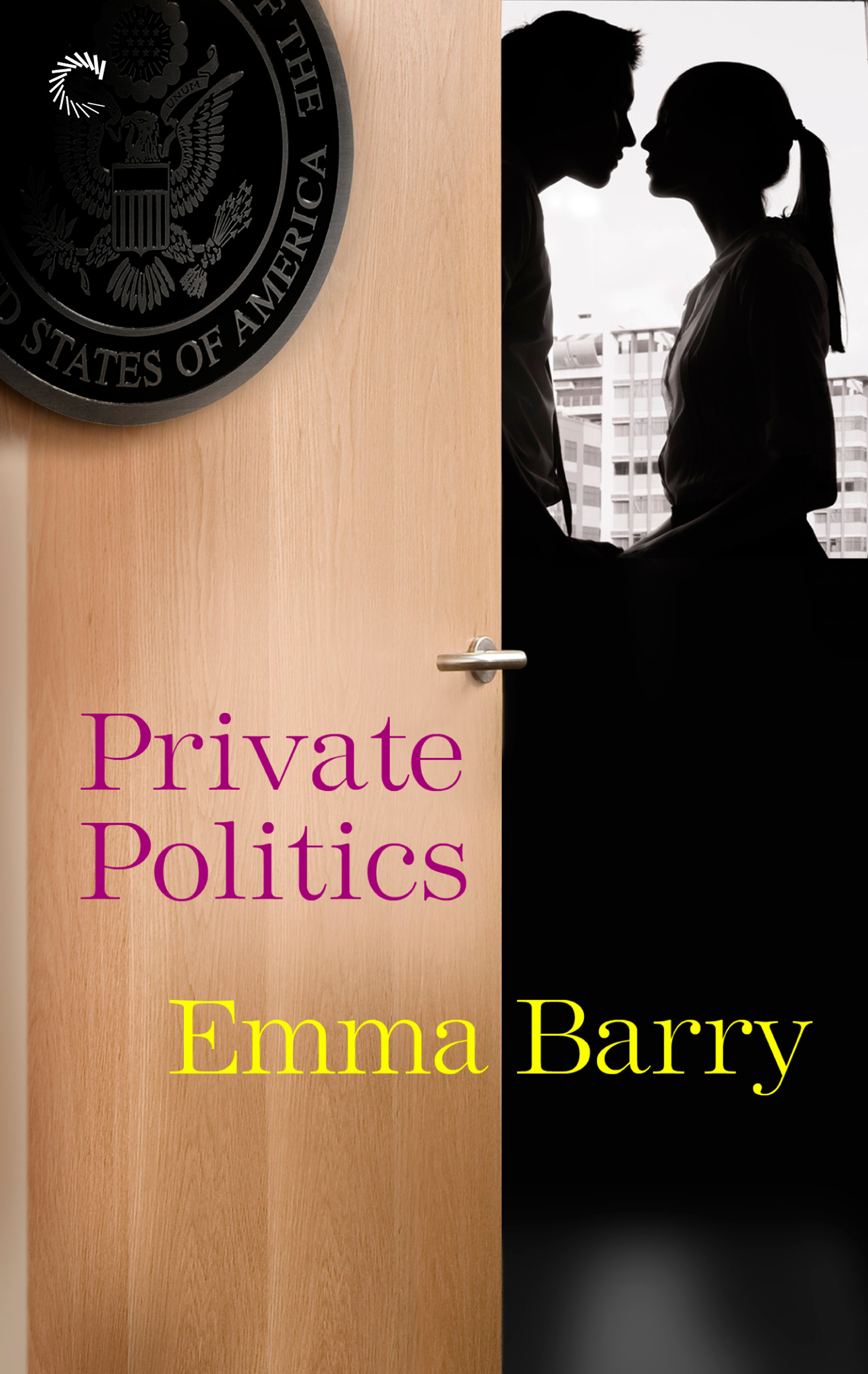
Happy Book Birthday, Private Politics!

book cover reading

One year ago, Liam and Alyse’s story stepped out into the world. An author probably shouldn’t choose favorites, but Liam is my favorite hero I’ve written: he’s smart, enthusiastic, and cuddly. He loves Alyse’s ambition and he wants to help her get what she wants on her terms. He’s not a pushover, and when Alyse takes advantage, he protects himself. But he wants a partner not a doormat.

Here are my top five Liam moments:

  1. He’s self depreciating: “He sat up a little straighter and pushed his shoulders back. After all, if she was going to look at him, really look at him, for the first time maybe ever, he might as well try to maximize his assets. Such as they were. Never mind, he had no assets, which was the problem, but still, he wanted to look like someone she could trust.” (Kindle Locations 323-325)
  2. He’s crazy into Alyse: “She shifted against him and the fantasy faded. It wasn’t like he needed a story to make this moment meaningful. Alyse, in his arms, wanting to be there, was enough. He was so far gone for her it wasn’t even funny.” (Kindle Locations 621-623)
  3. He loves his grandma: “… his mother had chosen a picture of him with his arm around his grandmother taken about a year prior. She’d cropped the image, but you could still see the edge of a little gray head at his shoulder. Not understated, that. She’d probably barely restrained herself from adding a caption, ‘And he loves family.’ At least he was laughing. At least he looked like himself, relaxed and a bit sloppy. No false advertising here. Well, he did like family. He wasn’t ashamed.” (Kindle Locations 697-701)
  4. He’s into long, lingering glances: “One block became another. Their bodies swayed as the cab jolted over the District’s bumpy streets, but neither of them looked away. If only for tonight, if only because she was scared, he might have a shot with her. It might be taking advantage. It was certainly stupid. It wasn’t personal, he knew it wasn’t personal, but it might be enough to be present. For tonight at least, she might be open to it, open to him.” (Kindle Locations 1136-1139).
  5.  When he finally goes for it, he’s absurdly hot:”In an exhalation more breath than voice, he urged, ‘Tell me what you want.’

    That was all? Then he’d do it?

    ‘Kiss me.’ Her voice was husky, needy and desperate. Damn transparent voice. Still he didn’t move.

    ‘Say my name.’

    She trembled. ‘Liam, kiss me.'” (Kindle Locations 1618-1620)

Don’t worry–he does!

If you need a dependable, sweet, cuddly new book boyfriend, check out Private Politics.

Coming Soon

image/text promo for Star Dust. it reads: dukes have curricles. bad boys have motorcycles. these guys have big rockets.

Star Dust is the project Genevieve Turner and I have been working on for a while. It’s with the copy editor and we’re very excited about it. We don’t have a definite release date, but we’re shooting for early October.

If you want to be the first to know when Star Dust is live, you can sign up for the Fly Me to the Moon mailing list. And if you want a sneak peek, check out the book’s Pinterest board.

Picturing Inspiration

Last week, my mother sent me four boxes filled with all the books she’d collected when my brother and I were kids. She and my father are moving and as my brother doesn’t have any children, I got them. I gnashed my teeth because we just moved and our house is filled with books. But who turns down more books? Certainly not this girl!

As I unpacked, inside one of the boxes I found Hilary Knight‘s Cinderella (1978). Of all the books she sent, this was one I sat down with re-read on my own, cover to cover, as soon as I took it out, a tingling sense of remembrance settling over me with each turn of the page.

Knight is most famous as the illustrator of Kay Thompson’s Eloise (1969). In comparison, his illustrations for Cinderella demonstrate the effects of the 1970s on aesthetics, particularly in his use of color (think Precious Moments).

But what amazed me was how well I remembered the pictures: the gauzy sleeves on Cinderella’s ball gown. The ginger prince in his pale blue coat. A discarded blue bottle and a lizard in the corner of the garden. The wisps of hair escaping from Cinderella’s chignon. As a child, I had studied these illustrations. Closely. Obsessively.

What I hadn’t remembered was this this version of Cinderella is set in the Regency (or perhaps a decade later, I’m not good with clothes and dates). At the very least, these images could serve as costume inspiration for the Austen adaptations I’d be avidly consuming a few short years after I put this book away.

I closed the book. I reopened it. I read it again. Holy cow. Maybe Hilary Knight’s illustrations for Cinderella primed me to love Austen and Regency/early Victorian England. Maybe Knight is responsible for everything that followed.

I’m utterly certain that this book set me up to appreciate Maurice Sendak’s illustrations for The Nutcracker (which Brain Pickings profiled here), a book I loved so much and for so long I took it with me when I moved out of my parents house. Sendak’s illustrations for Hoffmann’s novella (set in the late 18th century) got me into bel canto opera, which led to…

You get the point: inspiration is nested. It’s random. It’s unpredictable. And I suspect that we all process it differently. Books and words inspire me, but I don’t tend to remember them quite as clearly as I do images. Ditto for music, taste, and smell, all of which are more abstract.

When I reopened Knight’s Cinderella, I realized that for me, the picture might be the most important thing. Or at least the one that stays with me the longest. The swept of a line, the shade of blue, the quality of light: these have become part of me forever.

So what inspires you? What’s the core of what you’re writing or reading these days? And did anyone else have this edition of Cinderella?

Odds and Ends

I’ve been writing words. I’ve been editing words. I’ve been having conversations about covers. There will, in other words, be new releases from me this fall.

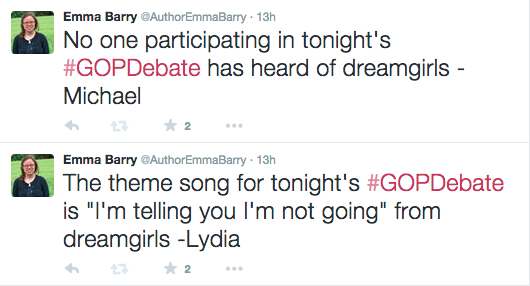
texts from Lydia and Michael re: the GOP debate and Dreamgirls

But in the meantime, I live tweeted parts of last night’s GOP debate from the point-of-view of Lydia and Michael from Party Lines. It’s mostly snarky commentary; nothing too partisan. You can see all of them on my timeline.

And if you like that or if the upcoming election has you in the mood for a banter-y, election, cross-party romance, remember that Party Lines is available wherever fine e-books are sold, including AmazonB&NCarinaiBooksKoboAll Romance, and Google Play.

Truth’s Superb Surprise

I try not to write about writing itself on my blog because such topics tend to only be of interest to other writers. Also, I don’t always (okay, I seldom) feel like I have something original or worthwhile to say about the writing process. But to break my own rule and be a little cryptic…

For a long time before I started writing fiction down, I was writing it in my head. I didn’t realize it, but I was carrying around a bag and I was putting all sorts of things into it. Jokes that I (and those around me) told. Words that I liked the sound of. Bits of description. Images. Smells. Fragments of motivation and psychology. And questions–so many questions. Why did he do that? Why did I say that? Could this have happened another way? What is she thinking? Etc.

When I started writing, I began taking things out of the bag. I recently re-read Special Interests and it amazed to me how much truth I told while lying. The bones of the scene, the things that were happening in terms of the plot or characterization, would be wholly fabricated. But every single detail of the scene would be true. The book is a patchwork quilt of my experience in and observation of the world.

For a long time in my writing life, I would take things out of the bag and tap them into my stories slant (sorry, Emily Dickinson, that’s one of those words). I mean to say that I used a trick not too differently from how it happened or where I had once seen that sweater or how that thing had tasted. I just sort of twisted a bit.

However, I’ve been writing something that is (for me) very different and crazy. But here’s the thing: I’m using just as much stuff out the bag as before. Maybe more. I’ve discovered whole other rooms, whole other continents, in the bag. So what I’m trying to say is that I am larger than I thought I was. And for the moment at least, that makes me less scared of my writing than I’ve been in a long time.

We, as writers, are told to develop a brand. To make a promise to our readers and to deliver on it in terms of voice and tone and story and setting. What I’m writing now doesn’t feel all that off-brand. It feels like me…but slant. And on the bias, there are entirely new ways of being.

What makes good criticism?

Sorry it’s been so long! I was trying to write a lot of words, which was I doing until about two weeks ago. Then we went on vacation and we moved into a new house. We’re still very much in unpacking mode and at the end of every day I fall into bed exhausted. I haven’t been reading or writing–and this somehow makes me more tired.

Also, while I’ve been happy with the words I’m writing, I’ve been experiencing professional disappointment that has me thinking about my voice and the market. I don’t have conclusions about this yet, but I’ll let you know.

Anyhow, the real point of this point: what is good criticism? Natalie of Pretty Terrible posted this question on Twitter. For reasons related to my academic training and my area of study, it is something I have very strong opinions about. I was going to respond there, but it would be too long. I’ll keep the abbreviated bullet point format of Twitter, though:

  • Good criticism is an intellectual, and not primarily emotional, response to a text. I’m not saying there’s no emotion in criticism—indeed, really good criticism often comes from explaining one’s emotions—but isn’t primarily about “the text made me feel X.” Criticism is what comes after that stage.
  • Good criticism is not primarily evaluative. It’s NOT about saying whether the text is good or bad. When I teach this idea, I often show students a Siskel and Ebert film review (say this one). Then I show them Matthias Stork’s amazing series on Chaos Cinema (here’s part one). What’s the difference? Siskel and Ebert are trying to tell you whether you should go to a movie—is it worth the price of admission? Stork is trying to tell you what this new style of film is. He has an opinion about whether it’s a good or bad development, but he’s mostly trying to define it and tell us how it works. Stork is critical; Siskel and Ebert evaluative.
  • Good criticism has a clear idea about what it’s doing. So any individual entrant is joining a larger conversation. This conversation (or method) can be formal. For example, there’s a set of writing that lays out Marxist critical discourse, or formalism, or New Historicism. But the critical approach can be more squidgy. Either way, people over time develop critical schools of thought and any given critical gesture is in the style of (or in response to) one or more of these.
  • For example, in romance (and I’m sure this is true in other fan communities), popular feminist discourse is important. We talk about whether heroes are alpha or beta (or caretaking alpha or alphaholes), which is another way of talking about how the texts construct masculinity. Also important: genre studies. What tropes does the text use? And does it just replicate the trope, does it make it fresh, or does it subvert it?
  • Good criticism, then, tells me how the text works (and to do this, it must substantively engage with the text) and then puts this into a genre context and a large critical conversation.
  • Here are a couple of critical responses that I think are good: Olivia Waite on Jenn Bennett’s Bitter Spirits and Natalie Jo Storey in the Los Angeles Review of Books on sheikh romance. These make good comparisons because they both use gender studies to talk about how the texts “do” gender and post or neo-colonialism to talk about how the texts “do” race. They do make some evaluative judgements, but mostly they’re talking how the texts work. They’re explicit about the critical moves their making (good criteria) and they engage substantively with specific works. Waite focuses on one text while Storey takes in an entire genre–but she’s still citing lots of specific examples.

I’ve used academic language for this definition, but I have serious concerns about how this goes down in the academy. I don’t think academics are always good at explaining their critical criteria and group-think leads them to only ask certain questions and only of certain texts. Part of what I love about romance is that there are really cool critical conversations happening that I never heard in the academy.

Finally, to be clear, I don’t think criticism is the only valid approach to texts. GIF/squee reviews do important work, I read things all the time that I never move past the “digestion” stage with, etc. Criticism isn’t higher or more valid or anything. It is its own flavor and pursuit and sometimes it’s what you want and sometimes it’s not.

So, what do I have wrong?

Special Interests On Sale!

Good news: from now until June 22, Special Interests is only 99 cents! This price should be live everywhere it’s for sale in both the United States and Canada. In the year since its release, this is the first time Special Interests has been on sale. If you’ve been waiting to buy it, now is the time.

stylized text against pretty backdrop that reads,

If you need them, here are the buy links: Amazon | B&N | Carina | iBooks | KoboGoogle Play.

Since my books aren’t on sale often, and I’d like more people to check out the series, I’ll be obnoxious about this on social media in the next two weeks. I apologize in advance!

Also, there are three complete or nearly complete things on my hard drive, two of which I’m planning to self-publish this year. So if you’ve been waiting for new words from me, they’re coming.

ETA: I scheduled this to go up over the weekend, but as of Monday morning, the sale price isn’t live yet anywhere except Amazon Canada. I’ll let you know when it shows up.

ETA2: Okay, the sale price appears to be up most places and should be everywhere soon.

Seven Underrated Romantic Comedies

For at least ten years, I’ve been reading about the demise of the romantic comedy (aka the rom-com). I even blogged about how there don’t seem to be many rom-coms in theaters and how many recent attempts are, well, not very good. Katherine Heigl made a living for a while playing up-tight career women who could only find love once they’d been humbled in films like The Ugly Truth and 27 Dresses (and even Amy Adams and Jennifer Lopez got in on the act in Leap Year and The Back-Up Plan, respectively).

The past 20 years of film have seen rom-coms that are pretty but in which the romance isn’t compelling (Letters to Juliet), comedic movies in which the romance is compelling but not the focus (Pitch Perfect, Easy A, Bridesmaids, Monsoon Wedding), dramatic films with happy ending romances (The Young Victoria and a host of other biopics), and romance-focused flicks without happy endings (Bright Star, Once, (500) Days of Summer, In the Mood for Love, Moulin Rouge). I started my Fine Romance Friday posts in response to the trend, but not all of the movies I’ve written about are rom-coms and many are older films made before the mid 1990s.

So in that spirit, I want to provide a list of what I see as the most underrated rom-coms of the last 20 years or so. I wouldn’t argue that these are very best rom-coms made in that period, but everyone knows about Amelie and The American President (right?). I’m not going to do full write ups, but I’ll drop in the trailer, link to IMDB, and write a paragraph about why you should check it out. I organized these chronologically. Let me know what I’ve missed in the comments!

Continue reading “Seven Underrated Romantic Comedies”

Logistical Note re: Brave in Heart

The first book I published almost two years ago was a historical romance set during the American Civil War called Brave in Heart. It’s little (40Kish words) and it’s very much a first book, but I’m proud of it. Which is why I asked my publisher for my rights back. And today I got them.

What this means is that Brave in Heart will be disappearing from retailers in the next few weeks. So if you want it, you should act fast. (And it is currently in Kindle Unlimited and Scribd, FYI.) At some point I’ll produce a new cover and self-publish it. Heck, maybe I’ll even finish the sequel I teased you with at Valentine’s, but that won’t happen any time soon. I’ve been thinking a lot about my writing and the market and I need to figure some things out before I have time to focus on Brave in Heart.

So the tl;dr version: Brave in Heart is going to be off the market soon but it may return…someday.

PS The anniversary of the start of the Battle of Chancellorsville is tomorrow. Chancellorsville plays an important role in the novel. I went there, took pictures, and talked about it here.

Both Alike in Dignity

Over the weekend my friend and critique partner Gen Turner started a Twitter imbroglio when she confessed that she doesn’t really connect with the novels of Jane Austen. I was traveling so I didn’t get to follow all the nuances of the ensuing discussion, but several of us posited that there seems to be a schism in romancelandia (and probably the broader culture) between folks who love the novels of Jane Austen and those who prefer those by the Bronte sisters. Elisabeth Lane compared it to the Star Trek vs. Star Wars debate.

If so, it makes sense. While Austen died in 1817 when the Bronte sisters were infants, Charlotte Bronte famously disliked Austen’s novels, saying Pride and Prejudice was “An accurate daguerreotyped portrait of a common-place face” or, in other words, realistic but boring. In another letter Charlotte Bronte wrote, “The Passions are perfectly unknown to [Austen].”

There’s a lot I could say here about how Austen is more properly grouped with the 18th century novelists than the 19th century ones. Austen has a more Enlightenment view of human nature and love, not to mention that she wrote novels with strong romantic elements not genre romances per se. In contrast the Brontes–who are hardly a united front as my favorite Kate Beaton cartoon spoofs–were more influenced by Romanticism and Wordsworth’s “spontaneous overflow of powerful feelings.” They also wrote for a vastly different audience.

But that’s not my area of expertise and so I’ll refrain.

Instead I want to suggest that Austen/Bronte debate is unnecessarily adversarial. Genre romance descends from both, as Pamela Regis explicates nicely in A Natural History of the Romance Novel, but I’m going to argue that genre romance uses Austen and Bronte for different things. To my mind, Austen provides a set of plots for romance and Charlotte Bronte provides an aesthetic for romance prose.

Continue reading “Both Alike in Dignity”