The Conversion Imperative

(This is the latest entrant in a series my critique partner, Genevieve Turner, and I have been writing about religion in genre romance. The first two posts are here and here. This and the following post were mostly written by Gen.)

Why are characters with religious convictions rarely portrayed in non-inspirational romance? And how is this absence connected with the prevalence of the conversion narratives in inspirational romance?

Emma and I began thinking about these questions when we were discussing the lack of religious references in genre romance, a state of affairs we found puzzling—especially in historical romances. In her series on religion and romance, author Ros Clarke raised the idea that perhaps we don’t see many people of faith in genre romance because those stories are always shunted to the inspirational subgenre.

While batting around our ideas over email, one of our theory was that religion is not mentioned (often) in genre romance because religious differences (at least differences within Christian denominations) are no longer a source of overt conflict in the modern western world.

(Obviously religious conflict remains a big deal globally. I would love to see more romances from places other than the US and Western Europe, either contemporary or historical. But we definitely don’t live in an ideal world. So while this post and series will be western-centric, this is not say that the genre should be. Yay for more diversity!)

I’m old enough to have a grandmother who told me never to discuss politics or religion at dinner parties. The politics bit is less taboo these days (which is why Emma has written a series of political romances), but the “religion as private” prohibition still has currency.

Continue reading “The Conversion Imperative”

Romance as Conversion

Santa_teresa_di_bernini_03
Image used via WikiCommons License, by Sailko

So a funny thing happened after lots of people read and commented on my post about romance and religion: a series of demands ate my time and made it difficult for me to finish this post. I also found the attention somewhat paralyzing. It’s easier to blog if you think no one is going to read what you have to say—because if people are going to read it, then one is under an obligation to say something interesting and unique.

I am sorry about that; and since I can’t leave the conversation unfinished, and because Gen has some lovely posts on the subject that deserve your attention, I want to offer a few unformed thoughts about how non-inspirational (straight genre) romance may still have a central conversion narrative, but one that substitutes romantic love for religious faith.

Conversion stories and genre romance share a narrative structure. In the opening of each, we generally find our hero or heroine untouched by either romantic love or faith and claiming to be happy without it. But beneath the surface there is an aching lack.

Cue the meet cute! Our hero or heroine is exposed to the charms of their future partner in romance, or the illuminating truth of the gospel or the guiding actions of one of the faithful in conversion stories. The hero or heroine begins to doubt the previous aversion to love or faith.

In the final triumphant act, our hero or heroine is fully converted, often in a rush of some strong emotion forcing them to declare their newfound love or faith. And then they live happily ever after–either in this world, or in Heaven if they’ve been martyred.

Continue reading “Romance as Conversion”

The Art of the Love Letter

Brave in Heart Letter Page 1

Valentine’s Day is nearly upon us, which means that it’s time for me to write a love letter. And by that, I mean actually sit down and write one, with the pen and the paper and the envelope.

I’m not a big “nostalgize the form” kind of gal. I want nothing with Ludditism here. Once I got an e-Reader, I was happy to abandon physical books at least for pleasure reading. I can’t remember the last time I left a voicemail because it takes less time to read a text message. In general, out with the old!

But there is something about the physical experience of handwriting when it comes to the love letter that I want to maintain. The sound of the pen, the brush of the paper over your skin, the tactile event-ness speaks to what you’re trying to capture on the page. The handwritten love letter beautifully marries form and content.

When I wrote Brave in Heart, I handwrote parts of the novel out of necessity. My kids were in a grabby phase and I didn’t have full-time childcare. If I wanted to write when they were up, and sometimes I did, then handwriting was better than typing as the computer was too much fun to ignore.

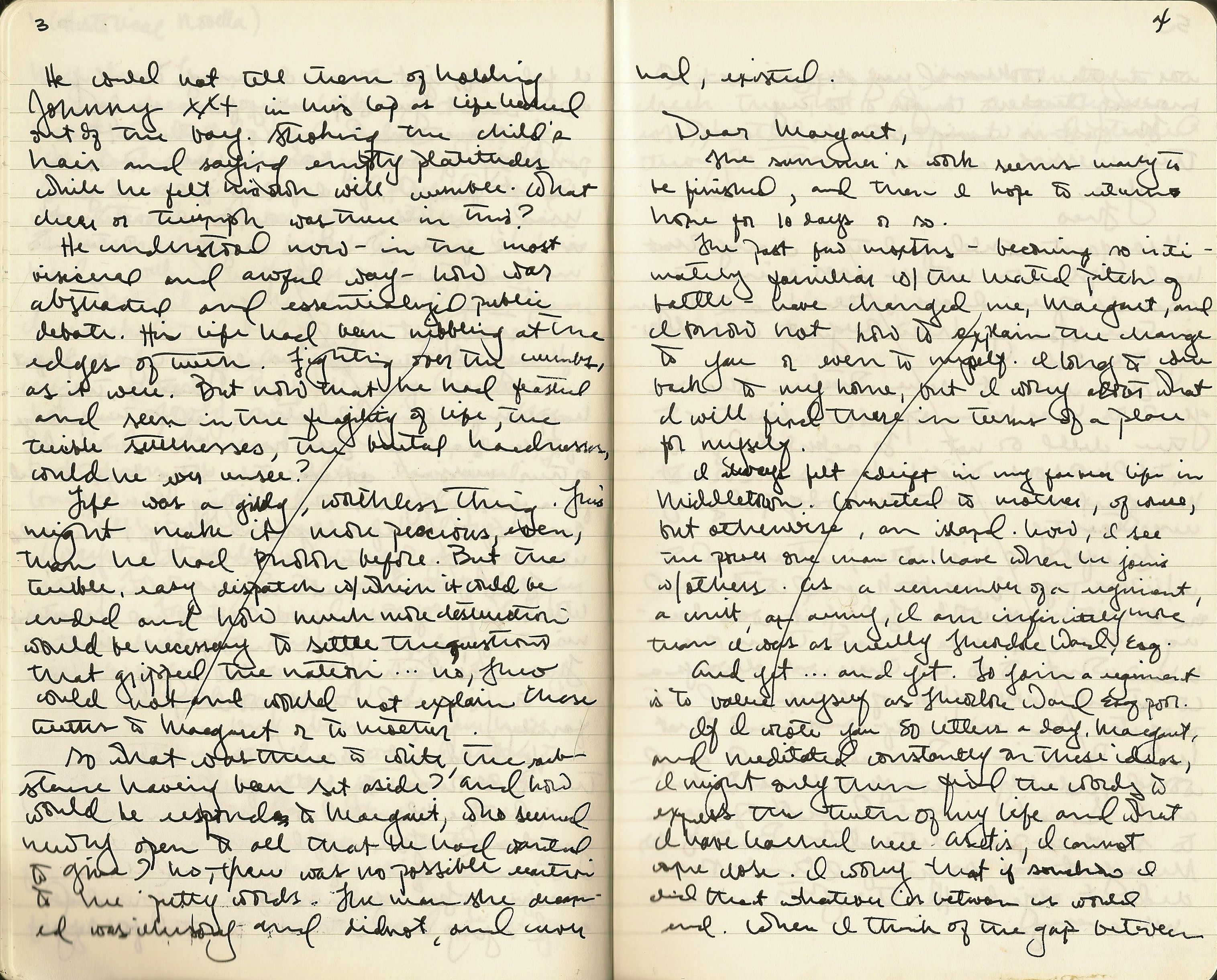
But ultimately, certain scenes demanded to be handwritten, including the correspondence bridging two time gaps in the novel. I could not have typed the first drafts of those letters and generated what I did. They had to be written. What resulted is a sort of facsimile of the fictional object. Simulcra love letters.

And precisely because your beloved’s hand touches that same page you hold, his mouth wets the envelope, and so on, the love letter can be an object of veneration. Sorry, Mr. Benjamin, this is one aura I have no desire to destroy. (Frankfurt School digression: though he’d probably agree with me because there’s no mass production involved, at least if you start with blank paper and not a Hallmark card.)

A love letter is a work of art. It is a relict. It is timeless.

And now I’ve got to get to work on mine!

Brave in Heart Letter Page 2

*If you were to try to read them, these letters contain minor BiH spoilers. Edited versions appear in Chapter 11 of that book.

Sale! Sale! Sale!

For the month of February, my Civil War-set historical romance Brave in Heart is on sale for $1.99. This is the first time it’s been discounted since releasing in July so if you haven’t picked it up, now would be a good time. If you need a reason to read it, here’s my no doubt compelling list.

Right now, that price is only at Amazon, but I’ll update this post if it shows up anywhere else.

Blurb for Special Interests

I’m totally not bouncing up and down or anything because the back cover copy for my next book is out. No, not at all. But since you mentioned that you wanted to see it (you did right? I thought I heard something) here is the full blurb for Special Interests.

Compared to love, politics is easy

Union organizer Millie Frank’s world isn’t filled with cocktails and nightclubs…until she’s turned into an unwitting minor celebrity. As if being part of a hostage situation wasn’t traumatizing enough, now her face is splashed across the news. But Millie’s got fresher wounds to nurse—like being shot down by the arrogant bad boy she stupidly hit on.

Parker Beckett will do whatever it takes to close a deal for the senate majority leader, including selling out union labor. Charming and smart on the surface, he’s also cynical and uncommitted—an asset on the Hill. But something about Millie has stuck with him and when negotiations bring her to his office, Parker breaks his own rules and asks her out.

Parker can’t understand how Millie has retained her idealism in a place like D.C. Millie can’t believe what Parker’s willing to sacrifice in order to pass a budget. But as they navigate their political differences, what grows between them looks a lot like a relationship…and maybe even a little like love.

If you want, you can add it to your Goodreads shelves or preorder it on Amazon.

On Religion and Romance

Why don’t romance novels tend to feature religion?

To spin it another way, why is it that outside of inspirational romance, religion tends to be excluded from or mentioned only in passing in non-inspirational (or straight genre) romance?

This is a particularly salient question in the historical context as church membership was a significant part of culture–in fact, perhaps one of the most significant parts of culture, especially in some of the popular settings for historical romances.

(For example, in The Feminization of American Culture, a book which despite its title is largely about Victorian American theology, literary scholar Ann Douglass argues that three-quarters of mid-nineteenth-century Americans were active members of churches, perhaps the highest degree of religiosity in American history. The period was also one of great religious fervor in the UK. And while we’re having a bit of an aside, let me say also that for simplicity’s sake, and because it reflects the bulk of the genre, this post will assume a western lens. I would love love love for the genre to be more diverse in terms of ethnicity, nationality, sexual orientation, class, race, religion, and politics than it is, so don’t take my discussion of the genre “as is” as endorsement of the status quo.)

Even in the contemporary period, religion remains a significant part of the cultural landscape. So if romance is a realistic genre, if it is frequently set in the world that we know, and if it represents scenarios that could happen/are familiar to us, then what gives with the absence of faith?

Continue reading “On Religion and Romance”

2013 in Review

The last twelve months have been strange, which is to say stranger than normal because the baseline in my life is, well, strange. At the start of the year, I had many goals and most have not been achieved. But here is what I did do!

  • I wrote about 100,000 words of fiction, which included finishing the book that’s now called Special Interests, writing a sequel to it, and starting three other projects. I also wrote innumerable words of non-fiction, emails, and blog posts (some highlights of the latter).
  • sold a book and then, because that had been so much fun, I sold three more.
  • My first novel, Brave in Heart, came out in July, whereupon I discovered convincing people to read your book might actually be more difficult than writing one.
  • But the sting of that faded because working with critique partners, beta readers, and editors who take you and your work seriously is awesome.
  • I revised Special Interests and now I can’t wait for you to read it (April 7, 2014; mark that down someplace).
  • I read many wonderful books, and even more articles, blog posts, and tweets about books. I generally came to feel like contemporary print culture is a vibrant place that I want to contribute to in as many ways as I can.

But for the past few weeks, I have been feeling very doldrum-y. My writing and creative process is like a tide. I’m the sun-bleaching-the-coral moment, waiting for inspiration to sweep back in. I know this: next year, I want to read more words, to write more and better words, and to work more productively and consistently.

As Yul Brynner once said in a movie, “So let it be written; so let it be done.”

I’ll see you in 2014!

Friday Flash Giveaway

So it’s my children’s birthday. Children’s plural. Birthday singular. Yes, three years ago I had twins and ever since then, it’s been sheer utter craziness.

To celebrate, I’m giving away one digital copy of my debut novel, Brave in Heart, via Amazon or Barnes and Noble (winner’s choice). Just a leave a comment below and I’ll pick a winner at random after midnight EST on Friday, December 27, 2013.

Cheers!

A Fine Romance Eve: Desk Set

There are lots of lovely Christmas romances on film, including The Shop Around the Corner, Love Actually, and While You Were Sleeping; many other holiday classics include secondary romance plots (It’s a Wonderful Life, Meet Me in St. Louis, Miracle on 34th Street, The Bishop’s Wife). Today’s very special Christmas Eve edition of A Fine Romance Friday is going another direction, however, a more Hepburn and Tracy direction, specifically to Walter Lang’s underrated 1957 film Desk Set.

Desk Set takes place in a totally fantasy world in which Hepburn’s television studio research library is being threatened by a new fangled invention, Tracy’s brand new computer. See, something like that would never happen in real life. Anyhow, Hepburn and Tracy play refreshingly middle-aged, smart, career-driven people who banter and bicker, reveal vulnerabilities and attractions, all while navigating a changing world.

Hepburn has gone about as far as a woman of her time could go, which is to the head of  small department with no further promotions in sight, and into the arms of a long-term boyfriend, a sniveling mid-level executive who doesn’t intend to propose and isn’t half-worthy of her. She’s a woman in need of the feminist revolution. Tracy, who has been so wrapped up in his work that he’s neglected to develop any social skills, bruises his way in, neglecting to be honest about the corporate changes at the studio and his technological innovation and setting up the Big Misunderstandings of the third act.

And it does feel like an act. The material’s stage roots are evident, Tracy isn’t half as convincing as an engineer as Hepburn is as librarian, and the computer, when it arrives, is amusing as hell. But Hepburn and Tracy are always magic together on screen and the two big holiday set pieces–one involving a sort of clown car on Thanksgiving and the other a wild office Christmas party–are worth the price of admission. Behold a marvelously drunk Hepburn and be grateful.

So among my many Christmas comfort viewings, I make room for Desk Set.

Merry Christmas and Happy Holidays!