Happy Fourth of July to my American friends and readers! (And happy treason day to everyone else?)
I imagine Millie, Parker, Alyse, Liam, Lydia, and Michael (from The Easy Part) would probably grill and watch their kids play and snark about the election. And all the astronauts, engineers, and other folks from Fly Me to the Moon would cook out at Margie’s and perhaps eat a Jello mold like this one.
If you want to replicate it on your own, I used this Sparking Summer Berry Jello recipe. I omitted the rum and scaled it up for this 10-cup mold which belonged to one of my grandmothers. It did not turn out perfectly, but it’s certainly festive and dramatic.
I’m in my writing cave at the moment, but I’ll be back soon with new words. Happy summer!
Following up on our earlier plan, the pseudo-romance book club held our discussion of Louisa May Alcott’s Behind a Mask (1866) last night. You can relive the entire thing on Twitter via the #MuirFTW hashtag, but here are some (spoilery!) highlights:
“Why, dear Emma, do you write mid-century romance, a subgenre which isn’t really a subgenre?”
“Well, gentle reader, the answer is simple: Down with Love.”
That’s right, this week’s fine romance Friday is Peyton Reed’s rom-com Down with Love (2003), which if you don’t know, stars Renee Zellweger and Ewan McGregor.
To talk about the plot of this movie is almost to the miss the point, but to blurb it briefly: Ewan McGregor is Catcher Block, “a man’s man, ladies man, man about town” who writes for KNOW Magazine (basically GQ). His newest assignment: write a tell-all about Barbara Novak (Ms. Zellweger), whose bestseller Down with Love is setting off a feminist revolution. He blows her off, then she insults him on TV, he becomes intrigued by her and pretends to be an yokel astronaut in order to seduce her and reveal to the world that she’s a–no, not that!–fraud. Except of course none of this works out. Hijinks ensue. And roll tape.
Look, you’re either intrigued by this set-up or you’re not. And I wouldn’t blame you if you want to run away screaming; this movie probably isn’t most people’s cup of tea. Except here’s the thing: I grew up watching way too much AMC, but back in the early 90s when AMC actually played classic movies. (Remember that?) And among those films were That Touch of Mink, Send Me No Flowers, Lover Come Back, and most of all Pillow Talk.
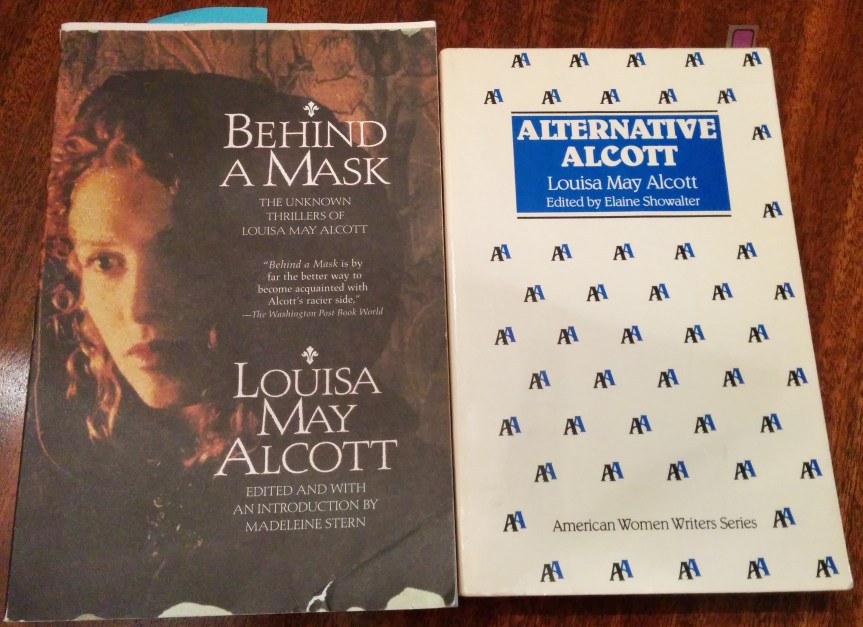
Following up on our discussion of The Odd Women, we’re going to tackle Louisa May Alcott’s Behind a Mask (1866). (Yes, I also own two paper copies of it.) Behind a Mask is a novella of about 40K words or a 100ish pages, which Alcott published under the pseudonym A.M. Barnard. It’s essentially a feminist retelling of Jane Eyre, but I don’t want to say much more because you don’t want to read any spoilers. Trust me: it’s tremendous fun.
I can’t find as many e-editions, but it is free at Amazon, iBooks, and Kobo (I can’t find free editions at B&N or Google Play). But fear not! At Project Gutenberg, you can download a range of file formats and then side-load them onto your device. If you want to add it on Goodreads, you can do so here.
Because it’s short, I think we can get away with a single discussion though I wouldn’t be surprised if it runs more than an hour. I propose Monday, June 27, at 9 P.M. EST. I’m not good at pithy hashtags; leave a comment if you can come up with anything good. I’ll see you then!
ETA: Just a note to say “retelling of Jane Eyre” is probably too strong. Alcott has clearly read Jane Eyre, and I feel like Behind a Mask is concerned with that book’s problem: how does a woman who is “poor, obscure, plain and little” make her way in the world? Both Jean and Jane are governesses, they both have multiple suitors, and some other scenarios occur in both. But Jean ain’t Jane, and thus her story has a different ending. I can’t wait to talk about it with you in June.
Last night, I tweeted a bunch of funny, sexist, offensive, and odd nuggets from Gen’s and my research for the Fly Me to the Moon books. I Storify-ed the entire thing here in case you missed it.
On to today’s movie recommendation: The Dish, a 2000 drama directed by Rob Sitch starring Sam Neill and Patrick Warburton.
Before we get into the plot, I must warn you that this is not technically a romance. Which is to say that there is a very small, though very sweet, romance subplot. But since my conceit with these posts is fine romances, the real romance here is with humans and the moon. What’s on that big rock in the sky? Can we get there? And what will we risk to share human exploration with the world? (And yes, I’m trying to tie it into my promo this week. Just roll with it.)
The Dish begins a few days prior to the July 1969 lunar landing. It’s set in Parkes, Australia, home to the largest satellite dish in the world. Parkes is one of the sites that’s going to help transmit the images from the moon to television sets everywhere.
The Dish is an ensemble piece, flitting from story to story: the bumbling mayor, with his devoted wife and his would-be radical daughter; the nerdy engineers and technicians who work at the dish who chafe under the oversight of the incredibly uptight engineer sent from NASA to oversee their work; and everyone else in town who can’t believe a man is going to walk on the moon and they are kind of, sort of adjacent to history.
The plot isn’t any more complicated than that. Things go wrong, and they fix them. History is achieved, and the pictures transmitted. It’s based on real events, although one major plot development is invented and I’m sure much of the rest is heavily fictionalized. But the charm of it comes in things that I can’t summarize for you: quiet conversations between friends, a fabulous late 60s soundtrack and perfect costumes, and this amazing thing that, almost 50 years later, it’s stunning that humans achieved. This isn’t an earth-shattering movie, but it’ll make you smile.
For this week’s fine romance Friday, cook up some lamb and watch The Dish.
It’s finally here! Charlie and Parsons have finally arrived. This book, y’all, this book. Gen and I wrote the first draft Earth Bound in about six weeks over the winter holidays. Once we started working on it, the words poured out.
It’s a workplace romance about two grumpy, brilliant people who are so smitten, but so bad at feelings. Erin from Binge on Books described it on Twitter as a cross between Mad Men, The Martian, and Pride and Prejudice. It’s dark, but funny. It’s about early computers, but it’s sexy. I just love it, and I hope you will too. (And for anyone who hasn’t read Star Dust or A Midnight Clear, you can start the series with Earth Bound no problem.)
How else could I appropriately celebrate a book I adore this much? I’d already made a retro feast for Star Dust. But there was an new frontier: booze-y Jello.
We held our final discussion on George Gissing’s The Odd Women last night. If you’re looking for them, here are my notes on part 1 and part 2. Since I know some people are still reading, I’m going to hide this under the fold. Read on at your own (spoiler) risk!
We’re only eight days away from the release of Earth Bound, a book of which I am fiercely proud. And to make sure you’re sufficiently excited about it, I’m going to share the prologue with you today.
Last night we had our second of three discussions on George Gissing’s The Odd Women (my notes from part 1 are here). We talked about important topics such as:
How does Gissing feel about his female characters? Does he like them? Are they caricatures? And specifically, how does he feel about working-class women? Is the book ultimately hopeful about the odd women finding purpose and happiness?
Who are the most redeemable and positive characters? (At the moment, Mary Barfoot, Mr. and Mrs. Micklethwaite.)
Is Monica’s marriage a cautionary tale? Was she right to leave her job and was Widdowston a viable alternative?
How scandalous was Everard’s “free union” proposition (e.g., Rochester’s offer to take Jane Eyre as his mistress, Mary Wollstonecraft’s tumultuous life, etc.)? And how repentant did Everard seem when discussing his scandalous past?
Where does Rhoda’s passion for her social reform come from since she is also unsympathetic to anyone who won’t adhere to her code (e.g., the young woman she turns away who later dies of suicide)? Was her fight with Mary caused by the same things as her fights with Everard? And is Rhoda an example of what literary scholar Laura Wexler called “tender violence“?
How did the language in Monica and Widdowston’s wedding scene reference virginity?
What is the book’s political message and is it uncut by Gissing’s artistic choices (e.g., whose point-of-view we get)?
For next week, I want to know if Everard truly changed. Will Rhoda agree to “a free union”? Will anyone find happiness? Will Virginia say, “Screw you all” and go read “feebler fiction” and drink brandy? See you for our conclusion Monday!
Last night, a motley crew discussed the first nine chapters of George Gissing’s The Odd Women. You can relive (or live) it by reading the hashtag #oddgals, but here are some of the highlights:
Dr. Madden: latter day Mr. Bennet (a la P&P)?
What is the relationship between work (or maybe purpose) and healthy and beauty?
Is Alice Madden’s vegetarianism about poverty or creeping progressivism?
We talked about the use of description; at times there’s lot of it, but then it goes missing during pages and pages of dialogue. Why is that? What effect does it have on a modern reader?
Why did so many Madden sisters die in chapter two?
The text criticizes “feebler fiction.” What’s up with that? (And what books was Virginia reading? Where can we find them?)
What is the text saying about morality and the city? How does London–or an existence outside of a traditional family/social structure–shape the lives and loves of the titular odd women?
Courtship vs. stalking: where is the line? And is there intentional critique in the text, or are we bringing it with us?
Predictions: Widowwson will be bad news, Everard is dissolute, and the money situation is going to get more dire for the Madden sisters.
We also discussed the emotional connection we felt (or not) to our protagonists Monica and Rhoda. The Gissing expert, Clarissa Harwood, suggested that we’d be more engaged emotionally, and not just intellectually, in their journey next week.




 Emma Barry