We’re only eight days away from the release of Earth Bound, a book of which I am fiercely proud. And to make sure you’re sufficiently excited about it, I’m going to share the prologue with you today.

We’re only eight days away from the release of Earth Bound, a book of which I am fiercely proud. And to make sure you’re sufficiently excited about it, I’m going to share the prologue with you today.
Last night we had our second of three discussions on George Gissing’s The Odd Women (my notes from part 1 are here). We talked about important topics such as:
For next week, I want to know if Everard truly changed. Will Rhoda agree to “a free union”? Will anyone find happiness? Will Virginia say, “Screw you all” and go read “feebler fiction” and drink brandy? See you for our conclusion Monday!
Last night, a motley crew discussed the first nine chapters of George Gissing’s The Odd Women. You can relive (or live) it by reading the hashtag #oddgals, but here are some of the highlights:
We also discussed the emotional connection we felt (or not) to our protagonists Monica and Rhoda. The Gissing expert, Clarissa Harwood, suggested that we’d be more engaged emotionally, and not just intellectually, in their journey next week.
So chapters 10 – 19 for next time!
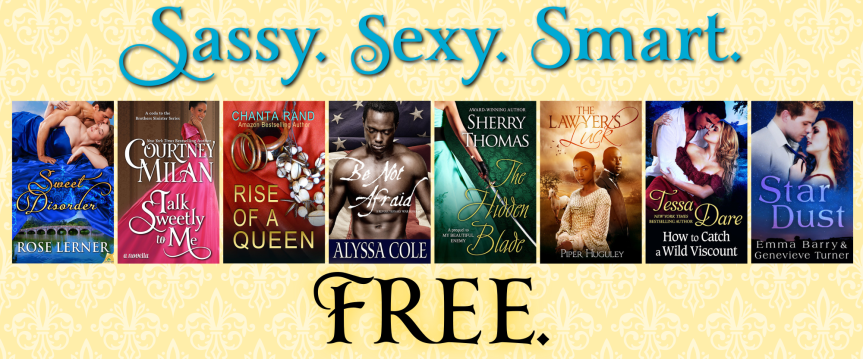
If you’re anything like me, you’re trying to pick the prefect Friday read. Something smart and hilarious would be ideal; if had cocktails and astronauts even better (or maybe dirty, sexy geeks or hot exes locked in an erotic encounter or love in a snowstorm)… but where to get it? Well, April’s no longer the cruelest month because I’ve got eleven books for you, and all of them are free.
That’s right: eleven contemporary romances–including Star Dust–free for this weekend only. Check out the full list and the links at Zoe York’s blog. But you’d better click fast: this offer expires Monday. (And note that Star Dust has a new cover, and it’s gorgeous.)
Happy reading!
Two years ago today, my second book released. I wrote it to collect incidents and personalities I observed in Washington and ideas I have about the state of American politics. This is probably why Special Interests is wonky and insidery. I truly never thought I’d sell it or that anyone would read it, so I wrote staffers who talked, thought, loved, drank, and snarked liked the one I was and the ones I knew.
I recently re-read it, and I’m a better writer and far more aware of the romance market than I was back in 2012 when I was drafting. But that I wouldn’t write it the same way now–or probably wouldn’t write it at all–is what makes Special Interests, erm, special to me.
It’s a book about two people who meet and are immediately gobsmacked, but because of the narrow yet deep differences in their personalities and worldviews, they can’t imagine a future together. But they can’t quite stay away from each other either.
This has always been one of my favorite bits. It’s from Millie and Parker’s first date.
Following up on my earlier post, there’s enough interest to commit to a book club on George Gissing’s The Odd Women (1893) to commence on Twitter on April 25. We chatted for about an hour starting at 9 PM EST last time; does that still work? And is #oddgals an okay hashtag?
The first nine chapters gets us through the first third, so let’s make that the goal for our first chat. Digital copies are available for free at Amazon, Barnes and Noble, Project Gutenberg, iBooks, Google Play, Kobo, and perhaps elsewhere.

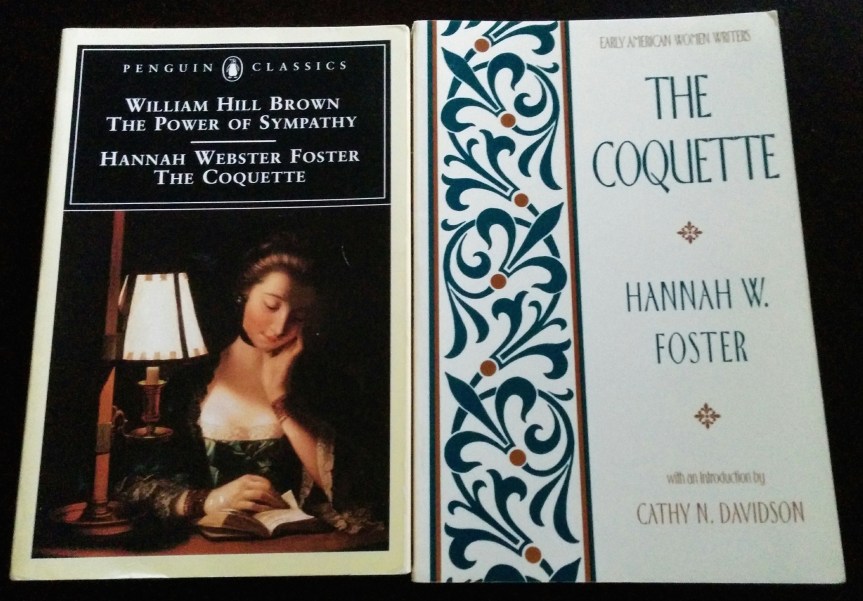
So in December and January, a group of us read Anne Bronte’s The Tenant of Wildfell Hall, and we discussed it here and on Twitter. As that was wrapping up, we talked about doing two more pseudo-book club discussions: on George Gissing’s The Odd Women and Hannah Webster Foster’s The Coquette. Spoiler alert: neither of these books have happily ever afters, but they engage with romance tropes and plots. I haven’t read the Gissing (which is set in late nineteenth-century London and addresses romance cross-class), but it looks terrific. And if you’ve been listening to Hamilton non-stop, you’ll enjoy what The Coquette has to say about courtship and femininity in early Republican America. Digital copies of both books are available free on Amazon, Project Gutenberg, and elsewhere.
I’m writing to gauge if there’s still interest in reading/talking about these books. If so, I’d like to propose that we discuss Gissing in about a month (maybe April 25, May 2, and May 9) and then Foster in July (maybe July 11 and July 18). We’d done Monday nights at 9 EST last time; is that still the best option?
I haven’t written a rambling, pretentious blog post in a while, and I have about 850 other things I should be doing, so…yeah.
I’ve been thinking about why I seem to have written so many romances that intimately describe the work of the characters, whether it’s how they negotiate the federal budget in Special Interests, how Anne-Marie made airline reservation in 1962 in Star Dust, or how Lydia prepares her boss for a presidential debate in Party Lines. (And if you like this sort of thing, don’t worry, there’s gobs of work stuff in Earth Bound.)
My initial thought is it might be related to the American notion of identity, which I’ve written about a bit before. For a modern USian, who we are is intimately tied to how we–or our family members–generate income. (I’m just southern enough to have heard young women say to each other at cocktail parties, “What does your daddy do?”)
But it isn’t a “modern” American thing, is it? This one goes back to Jamestown and the “work to eat” rule and the Puritans and their beliefs about idle hands being the Devil’s workshop. The contrasts and rejections we still see some people make between American and European economies are related to stereotypes about hard work and reward–and of course they are stereotypes. I don’t actually think people in the United States work any harder than anyone else, we just tie our mythos to our work in a way others don’t always, leading to great national tragedies such as Death of a Salesman.
I sometimes get questions about the exact mechanics of co-writing. Isn’t writing a book on your own tricky enough? How do you make something sound coherent when two of you are hacking away at it?
If you’re curious, I talked about my co-writing relationship with Genevieve Turner with the lovely Cobie Daniels in this podcast. (Also, Cobie’s debut novel will be out next week! How cool is that?)
Cobie and I talked about where the idea for the Fly Me to the Moon series, the research and co-writing process, the importance of critique partners, the state of historical romance, and Jello. Somewhat ironically, Cobie asked how Gen and I deal with conflict, but in early February when we recorded this, Gen and I hadn’t really hadn’t any conflict. But as we finished and did a first editing pass through Earth Bound, Gen and I finally disagreed about something: whether the possessive form of Parsons should be Parsons’ or Parsons’s. (Please weigh in on this important issue in the comments. And no, I won’t tell you which sides we were both on.)
If you’re looking for all the 60s recipes I made, they’re all here. And since we recorded the podcast, the Earth Bound cover and blurb have been released.
If thirty minutes of my dulcet voice and lucid reasoning isn’t enough of me, I talked to G.G. Andrew about my reading and the best kiss I’ve ever read.