Following up on our earlier plan, the pseudo-romance book club held our discussion of Louisa May Alcott’s Behind a Mask (1866) last night. You can relive the entire thing on Twitter via the #MuirFTW hashtag, but here are some (spoilery!) highlights:

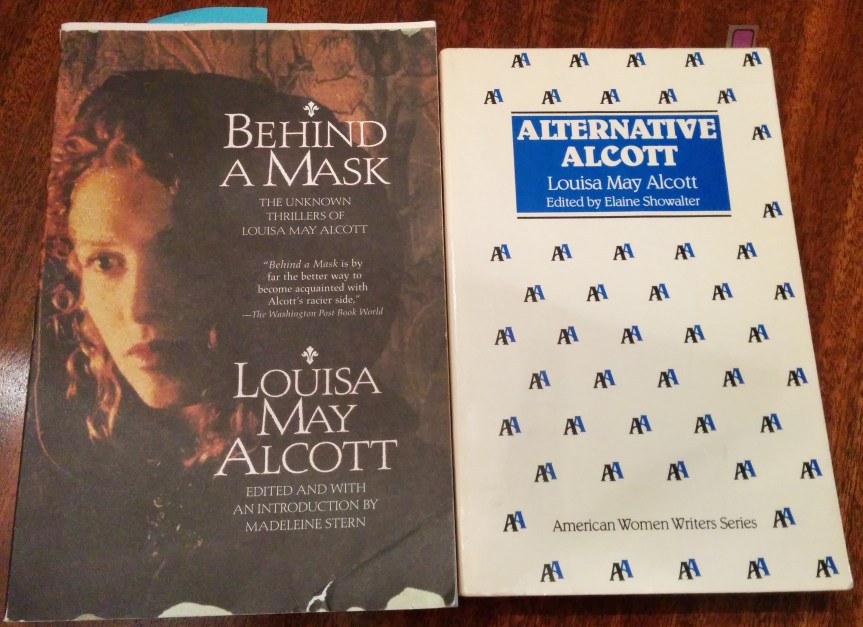
Following up on our discussion of The Odd Women, we’re going to tackle Louisa May Alcott’s Behind a Mask (1866). (Yes, I also own two paper copies of it.) Behind a Mask is a novella of about 40K words or a 100ish pages, which Alcott published under the pseudonym A.M. Barnard. It’s essentially a feminist retelling of Jane Eyre, but I don’t want to say much more because you don’t want to read any spoilers. Trust me: it’s tremendous fun.
I can’t find as many e-editions, but it is free at Amazon, iBooks, and Kobo (I can’t find free editions at B&N or Google Play). But fear not! At Project Gutenberg, you can download a range of file formats and then side-load them onto your device. If you want to add it on Goodreads, you can do so here.
Because it’s short, I think we can get away with a single discussion though I wouldn’t be surprised if it runs more than an hour. I propose Monday, June 27, at 9 P.M. EST. I’m not good at pithy hashtags; leave a comment if you can come up with anything good. I’ll see you then!
ETA: Just a note to say “retelling of Jane Eyre” is probably too strong. Alcott has clearly read Jane Eyre, and I feel like Behind a Mask is concerned with that book’s problem: how does a woman who is “poor, obscure, plain and little” make her way in the world? Both Jean and Jane are governesses, they both have multiple suitors, and some other scenarios occur in both. But Jean ain’t Jane, and thus her story has a different ending. I can’t wait to talk about it with you in June.
Last night we had our second of three discussions on George Gissing’s The Odd Women (my notes from part 1 are here). We talked about important topics such as:
For next week, I want to know if Everard truly changed. Will Rhoda agree to “a free union”? Will anyone find happiness? Will Virginia say, “Screw you all” and go read “feebler fiction” and drink brandy? See you for our conclusion Monday!
Last night, a motley crew discussed the first nine chapters of George Gissing’s The Odd Women. You can relive (or live) it by reading the hashtag #oddgals, but here are some of the highlights:
We also discussed the emotional connection we felt (or not) to our protagonists Monica and Rhoda. The Gissing expert, Clarissa Harwood, suggested that we’d be more engaged emotionally, and not just intellectually, in their journey next week.
So chapters 10 – 19 for next time!
Following up on my earlier post, there’s enough interest to commit to a book club on George Gissing’s The Odd Women (1893) to commence on Twitter on April 25. We chatted for about an hour starting at 9 PM EST last time; does that still work? And is #oddgals an okay hashtag?
The first nine chapters gets us through the first third, so let’s make that the goal for our first chat. Digital copies are available for free at Amazon, Barnes and Noble, Project Gutenberg, iBooks, Google Play, Kobo, and perhaps elsewhere.
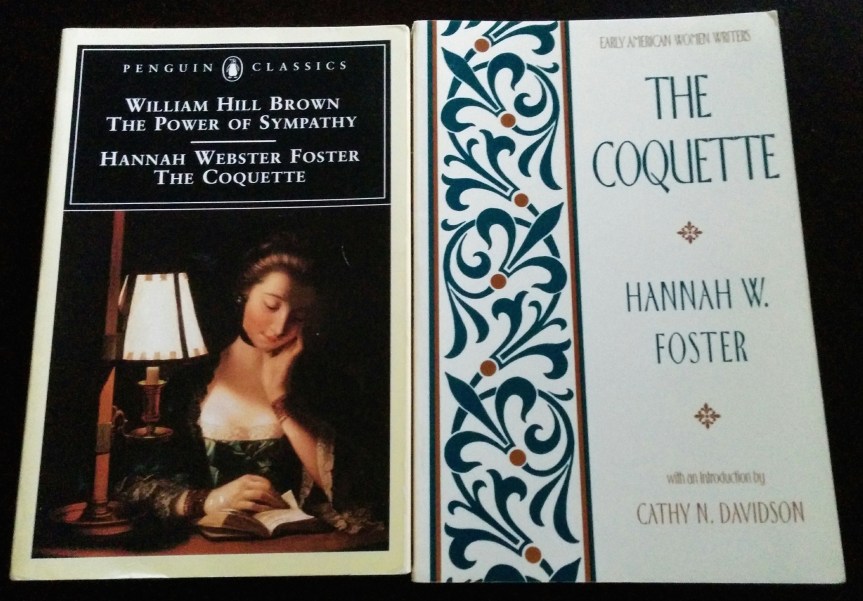
So in December and January, a group of us read Anne Bronte’s The Tenant of Wildfell Hall, and we discussed it here and on Twitter. As that was wrapping up, we talked about doing two more pseudo-book club discussions: on George Gissing’s The Odd Women and Hannah Webster Foster’s The Coquette. Spoiler alert: neither of these books have happily ever afters, but they engage with romance tropes and plots. I haven’t read the Gissing (which is set in late nineteenth-century London and addresses romance cross-class), but it looks terrific. And if you’ve been listening to Hamilton non-stop, you’ll enjoy what The Coquette has to say about courtship and femininity in early Republican America. Digital copies of both books are available free on Amazon, Project Gutenberg, and elsewhere.
I’m writing to gauge if there’s still interest in reading/talking about these books. If so, I’d like to propose that we discuss Gissing in about a month (maybe April 25, May 2, and May 9) and then Foster in July (maybe July 11 and July 18). We’d done Monday nights at 9 EST last time; is that still the best option?
We had our final discussion of Anne Bronte’s The Tenant of Wildfell Hall last night, and it was so fun! You can read the entire thing by looking at the hashtag #TOWH, but the topics covered included:
We also talked a lot about what if anything to read next. There seems to be enough enthusiasm for me to say yes we should schedule another read along. I was thinking March to give us time to recover.
The general consensus seems to be to do another “classic,” and one that would be of interest to romance readers (though not necessarily one with a happily ever after). Here are a few of the suggestions:
I would happily read any of these books, or whatever else people might be up for. The poll that I set up on Twitter last night ended up as a three-way tie. So let me know in the comments/via email/on Twitter/through a carrier pigeon what you’d like to do.
Thank you so much for joining us, and I’m looking forward to round two!
This week in our discussion of volume 2, we got Helen’s point-of-view and chewed on questions like:
There was also a long side discussion about the novel’s form. Volume 1 is epistolary, though since we never (or at least haven’t so far) met Halford, the conceit is a bit thin. Volume 2 is presented as series of diary entries. There are loads of 18th and 19th century epistolary novels, but there are fewer diary (or at least all diary examples). Go Ask Alice, Bridget Jones’s Diary, and “The Yellow Wall-paper” (ETA: oh, and the Adrian Mole series by Sue Townsend) were the only ones we could come up with. I’m curious to see what will happen with the narrative in volume 3.
We also talked about whether to do another read-along. I’m a big fan of obscure 18th/19th century American novels, like Fanny Fern’s Ruth Hall, EDEN Southworth’s The Hidden Hand, or Hannah Webster Foster’s The Coquette, but I’d also be happy to stick with European proto-romances–and I would definitely be on-board for a session on Balzac’s Cousin Bette, which I think is under appreciated. There was also a suggestion to read Edith Wharton (I’m always up for Wharton!) or maybe even some early romances like The Flame and the Flower.
So is there an audience for another read-along? If so, what and when? Let me know in the comments or on Twitter. And join us next week for our final discussion of Tenant volume 3!
 Emma Barry