The Blue Pencil

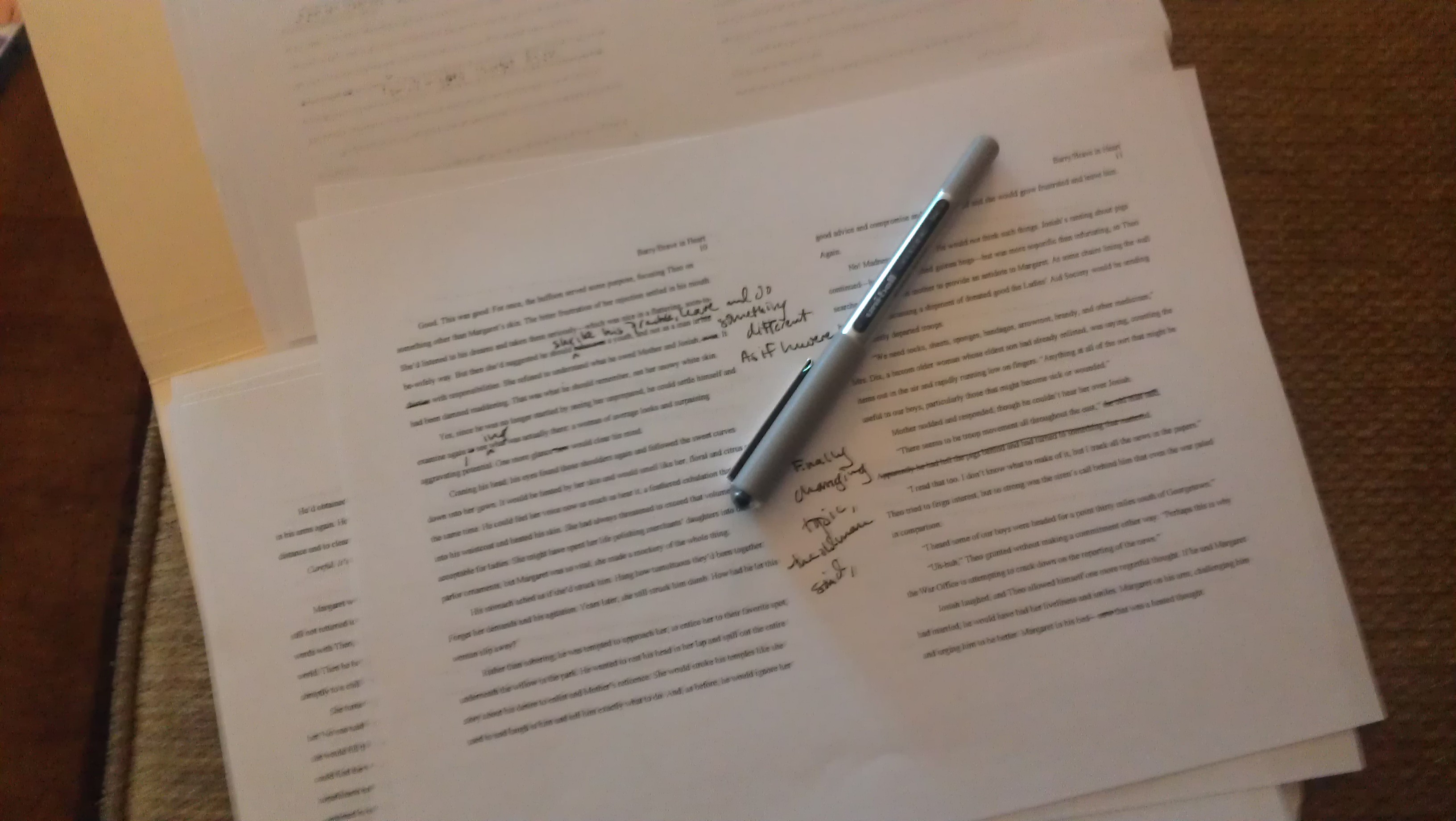
Historically, editors marked texts for revision with blue pencils. Hardscrabble publishing and journalist characters in nineteenth-century literature are often seen with those writing instruments tucked behind their ears or littering their desks. I once spent several long days in special collections at the Library of Congress reading the letters of an elderly writer written entirely in a large, scrawling hand in blue pencil.

Today, I think the words “red pen” conjure fear in the hearts of many — if we think of editing as happening on paper at all. But there’s something about the revision process that I actually like. It’s so wonderfully absorbing. So fabulously obtuse.

editing brave

At present, I’m working through a paper copy of Brave in Heart trying to finalize my changes. After this, there is only copyediting to go. So expect posting and Tweeting to be light this week. Lots of exciting teasers and posts are in the pipeline, however, and in a little less than two months, you’ll finally be able to read the book!

Now I’ve officially stressed myself out, back to my black pen…

eARCs of Brave in Heart

In a few short weeks, I should have the electronic advanced reader copies (eARCs) of Brave in Heart. We’ll pause here for a second while I squee. Okay, now that that’s out of the way, if you write for a site that reviews romance or historical fiction (and has previously reviewed romance), I would love to hear from you.

Brave in Heart is a short novel set in Connecticut in the first half of the American Civil War. It’s sensual but not erotic. The release date is July 1, 2013. For more information about the book, look here.

If you’re still on board, please email me at author.emma.barry (at) gmail.com with a link to your blog and your preferred format (.epub, .mobi, PDF). I will email them out by the third week in May. All that I ask in return is for an honest review. Please keep in mind that I’m limiting how many I give away and I can’t give one to everybody.

Anniversary of the Battle of Chancellorsville

One hundred and fifty years ago today in northern Virginia, the Battle of Chancellorsville began. It would take a week and claim 24,000 lives. That’s a number that requires a moment to sink in. Maybe it helps to write it out: twenty-four thousand men perished there in fighting over seven days.

Aside from the massive human cost, Chancellorsville is interesting to me because it was the beginning of the apex of the Confederacy militarily. Between Chancellorsville and Gettysburg it seemed quite likely that the Confederacy would win the war.

After years of study as a curious amateur, then as scholar, and now as a writer, I still can’t understand why things were so close for two + years and particularly for those two months. How could the Union — with more than twice as many people (the ratio gets even more unbalanced when you take into account Confederate unwillingness to arm the sizable enslaved population), almost all of the industrial production, and vastly superior infrastructure and wealth — not crush the Confederacy immediately?

The answers to that question (e.g., weak military leadership, hubris, bad luck, differences in culture, etc.) proved so costly it makes me ill. The American Civil War should have ended quickly, but it did not and thus 660,000 people died and cultural rifts were entrenched that still haven’t fully healed (see Confederates in the Attic).

But back to Chancellorsville! It was a decisive Confederate victory, though the death of Stonewall Jackson clouds this assessment, and it set up the dynamic for the war’s true turning point, Gettysburg. Because of his win at Chancellorsville — a win that occurred entirely because of tactics as he had been badly unnumbered — Robert E. Lee felt emboldened to invade the Union and that turned out to be a mistake, though the war wouldn’t end for two more years.

Chancellorsville has a long and prestigious literary history as the subject of Stephen Crane’s novella The Red Badge of Courage, F. Scott Fitzgerald’s short story “A Night at Chancellorsville,” a poem by Herman Melville entitled “Stonewall  Jackson,” and a diary entry by Walt Whitman from the very underrated Specimen Days in America.

On July 1, I’ll be waltzing quite brazenly into the party with my novel Brave in Heart, a historical romance that finds it’s turning point on the Chancellorsville battlefield. I hope you’ll join me there.

The Call

It wasn’t a call at all, actually. It was an email. But you know what I mean: the moment you get an offer from a publisher. The moment you start dreaming of long before you finish writing a book and which haunts you for years, until you begin to doubt that it ever will come true.

Mine came a couple of weeks ago.

Let’s rewind. I started writing fiction during National Novel Writing Month in 2011. My first effort, Together is Enough, is a primal scream about graduate school and the politics of higher ed wrapped in a romance novel. It’s basically a hot mess.

Despite the fact that Together is Enough is cliched, badly plotted, and not infrequently hilarious when it shouldn’t be, I enjoyed the writing. A lot. After a lifetime of reading fiction — obsessively, compulsively, voraciously — I was creating it.

It was hard, yo. And I had a lot to learn. Oh did I have a lot to learn! Continue reading “The Call”

New 50-Word Pitch

Theodore Ward is a man of deep passions and strong principles—none of which he acts on—and thus Margaret Hampton ends their engagement. But when Theo strives to win her back, they’re caught in the bloodiest conflict in American history.

Better, no? It’s going into the query stage.

A Look Ahead

The other day, I had a conversation with a potential critique partner. She asked, “What kind of books do you want to write?”

I’m embarrassed to admit, I was a little stumped. What I eventually said is that I want to write historical romances that show as much interest and enthusiasm in American history as the best European (read: British) historicals do and that I want to write sexy, youthful contemporaries that capture what I feel like is missing in the market today (e.g., romance between smart, ambitious professionals, etc.). The manuscripts I’ve completed so far are all pretty serious. I’d also like to lighten things up a bit and have a little more fun, while remaining true to myself and my voice.

In the next year, I’d like to finish The Easy Part and revise it. I want to finish the revisions of Brave in Heart and Together is Enough. I want to write a full-length book for the Dauntless Love series plus one other manuscript (either the next book in that series or a sequel to The Easy Part). I want to win NaNoWriMo, either with one of those manuscripts or maybe with a third project. I want to send out query letters for Brave in Heart and The Easy Part. I want to get ready to enter a manuscript in the 2014 Golden Heart. If I haven’t been able to find an agent or a publisher or to final in Golden Heart, I want to prepare to self-publish in mid to late 2014.

Most of all, I want to improve my craft. I’m a better writer now than I was 12 months ago. I want to be a better writer still 12 months from now. This means writing every day, focusing on showing versus telling, keeping my dialogue realistic and light, and becoming a better planner.

What are your 2013 writing goals?

Breaking Up is Hard to Do

I’m at that point in The Easy Part when I have to break the central couple up and seriously, I hate doing this. Someday I’m going to write a book where the central couple don’t get together until the very end just so that I can avoid writing painful scenes like the one I’m about to attempt.

For NaNoWriMo, I’m at 33,554 words, with 56,906 total in the manuscript. Let the bridge burning begin!

(Also, it isn’t on their blog but I think I can write about it: Brave in Heart finaled in the 2012 Novellas Need Love Too contest, sponsored by the Celtic Hearts Romance Writers. Yay!)

3M

I’m at 16,689 words for NaNoWriMo. I’m about 5,000 words behind, though I haven’t done any writing today. With some consistency and luck, I might be able to win. At the very least, I’m making good progress on The Easy Part, which now has 40,035 words and should be done by the end of the year.

Really, though, this post mostly serves as a reminder to check your characters’ names against those not just of the other characters in the book you’re writing but those in your other WIPs. The heroine in the recently finished Brave in Heart? Margaret. The heroine in The Easy Part? Millie (short for Amelia). The heroine in Brave in Heart’s sequel, which I’m plotting in my head? Matilda.

Why am I so fixated on the letter M?

I can’t change any of these names. I’m far enough along in the characterization that it would be weird. Margaret is Margaret. Millie is Millie. Matilda is Matilda. But I think it’s safe to say that I’m done with M-named heroines for a while.

Happy Happy Joy Joy

The first draft of Brave in Heart is complete. Here is a teensy-weensy teaser of the conclusion. Aren’t “the end” the most beautiful words in the English language?

Brave in Heart has been entered in the Novellas Need Love Too contests. Because, yes, I have a a contest entering problem. But also, I crave feedback deep in my soul.

I’d like to finish The Easy Part during NaNoWriMo — and yes, I know it’s not technically within the rules to to finish something you’ve already started, but oh well — and then start the second book in the Dauntless Love series in December.

Writing life is good.

The Stages of Hating Your Manuscript

I finished a radical revision of Together is Enough this week and I’m so very close to finishing Brave in Heart. So incredibly close. As a reward, I made the catastrophic mistake of picking up a book that shares both a genre and a setting with the former. It was a lovely book. Character-driven, tense but believable, politically progressive, compelling, and concise. Just terrific. After I finished, I said, “Damn it! I’ll never write anything as good as that!”

Those different processes — writing, editing, reading — are part of our lives as aspiring novelists. But they bring with them almost predictable attitudes towards our works in progress. I think it plays out something like this…

When you start drafting, you’re enthusiastic about your project. Out of all the ideas you have, this is one you’re writing now. So you naturally think it’s going to be awesome.

Then, you start writing and you hit the first plateau. It suddenly doesn’t seem so awesome anymore. If you’re like me, this happens at about 20,000 words.

After a lot of hemming and hawing, you push through and finish the manuscript. As you type those words, those lovely “the end” words, it is so gratifying. “Gosh darn, this project is awesome,” you think.

Continue reading “The Stages of Hating Your Manuscript”