What Happened to the Rom-Com?

When I look at about my Fine Romance Friday posts, a pattern emerges: most of what I’ve recommended so far are  older films, foreign films, or indies. What the heck has happened to the genre? Can Hollywood make a good romantic comedy anymore?

Jezebel had a nifty chart yesterday showing the decline of receipts for rom-coms compared to the meteoric rise in box office for super-hero movies. It’s sort of a random and not terribly enlightening comparison; critically, super-hero movies are experiencing a bit of a renaissance and rom-coms are in a rut, but that doesn’t mean the two are related.

But as someone who reads (and writes!) romance, it’s clear that there’s been stagnation in contemporary romance on film and I find that depressing. I think it’s related to a few trends: the focus on impossibly beautiful people, the forced quirkiness, the humiliation of the female protagonist, and the overall predictability.

Within, say, the best contemporary romance novels being written today, the characters are often more likable and more relatable than in the last five rom-coms I saw. Even keeping in mind that there will be a happily ever after, contemporary romance novels surprise me. I am rarely surprised by the mainstream romantic comedies of the past decade.

So, am I wrong? What am I missing? Or should I stick with the older films and those produced outside of the Hollywood machine?
A Fine Romance Friday: Summertime

I don’t know about where you’re at, but here, it’s hot. We’d been enjoying a nice spring and suddenly this week, summer arrived with heat and humidity leading the way. In honor of the shift in season, this week’s fine romance is Summertime, an underrated 1955 romanced directed by David Lean starring Katharine Hepburn and Rossano Brazzi.

It’s the story of an American secretary who has been saving her entire life for a big European tour. She stops in Venice for a few weeks, meets a silver fox Italian and, well, sparks fly.

I’m making it sound cliched, however, and Summertime is anything but. While the step up is predictable enough, nothing about the movie is quite what you expect. The cinematography is gorgeous — Lean was clearly getting ready for Lawrence of Arabia; the acting terrific; and the score haunting. And seriously, Brazzi can brood like no one’s business. While summer is still a novelty, slurp this one down with a bellini tonight.

Letting Go

In the wee small hours of the morning, I sent my final edits of Brave in Heart to the folks at Crimson. There’s one more copyedit stage, but that’s only for egregious, but minor, problems — typos, spelling errors, and so on.

Once I hit “send,” I sighed and smiled. I recognized that the feeling flooding my limbs had a name. Relief. And I enjoyed it for about twenty seconds before gasping panic expelled it from my body.

You mean this book I started writing a year ago doesn’t get to change again…ever? You mean that I’m stuck with these words in this order for the rest of time?

Continue reading “Letting Go”

The Blue Pencil

Historically, editors marked texts for revision with blue pencils. Hardscrabble publishing and journalist characters in nineteenth-century literature are often seen with those writing instruments tucked behind their ears or littering their desks. I once spent several long days in special collections at the Library of Congress reading the letters of an elderly writer written entirely in a large, scrawling hand in blue pencil.

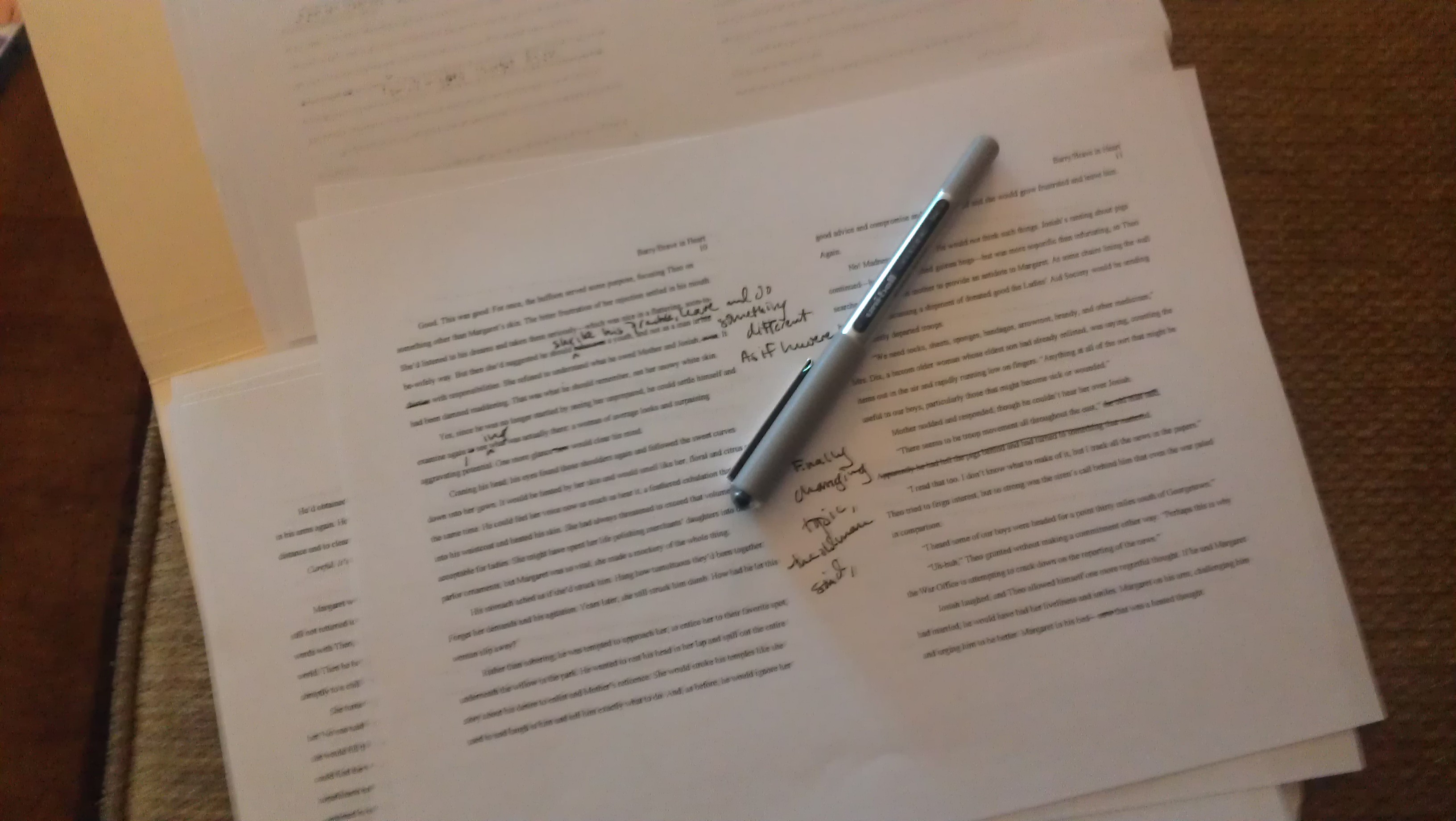
Today, I think the words “red pen” conjure fear in the hearts of many — if we think of editing as happening on paper at all. But there’s something about the revision process that I actually like. It’s so wonderfully absorbing. So fabulously obtuse.

editing brave

At present, I’m working through a paper copy of Brave in Heart trying to finalize my changes. After this, there is only copyediting to go. So expect posting and Tweeting to be light this week. Lots of exciting teasers and posts are in the pipeline, however, and in a little less than two months, you’ll finally be able to read the book!

Now I’ve officially stressed myself out, back to my black pen…

A Fine Romance Friday: Now, Voyager

There are moments in life — like when you’re trying to finish writing your dissertation, revising a novel, getting your two-year-old to stop biting his sister, and figuring out what you’re going to do with the rest of your life  — when you need Bette Davis.

“What would Bette do?” is a question that I have actually asked myself. The woman was always a tower of strength on screen. Sometimes she’s not at the beginning, but by the end, she’s found her way in a hostile world and she’s found her man too and she absolutely won’t apologize.

Everyone knows All About Eve — and I adore the central relationship in that film — but Now, Voyager is more focused on the romance. So this week’s fine romance recommendation is Irving Rapper’s 1942 weepie with Davis and Paul Henreid.

It’s the story of a frumpy, introverted Boston Brahman spinster who gets some new clothes, goes on a cruise to South America, and falls in love with Paul Henreid. As one does. Warning: it doesn’t feature a traditional happily ever after, but I don’t think you’ll care because Bette Davis will teach you how to live.

eARCs of Brave in Heart

In a few short weeks, I should have the electronic advanced reader copies (eARCs) of Brave in Heart. We’ll pause here for a second while I squee. Okay, now that that’s out of the way, if you write for a site that reviews romance or historical fiction (and has previously reviewed romance), I would love to hear from you.

Brave in Heart is a short novel set in Connecticut in the first half of the American Civil War. It’s sensual but not erotic. The release date is July 1, 2013. For more information about the book, look here.

If you’re still on board, please email me at author.emma.barry (at) gmail.com with a link to your blog and your preferred format (.epub, .mobi, PDF). I will email them out by the third week in May. All that I ask in return is for an honest review. Please keep in mind that I’m limiting how many I give away and I can’t give one to everybody.

Anniversary of the Battle of Chancellorsville

One hundred and fifty years ago today in northern Virginia, the Battle of Chancellorsville began. It would take a week and claim 24,000 lives. That’s a number that requires a moment to sink in. Maybe it helps to write it out: twenty-four thousand men perished there in fighting over seven days.

Aside from the massive human cost, Chancellorsville is interesting to me because it was the beginning of the apex of the Confederacy militarily. Between Chancellorsville and Gettysburg it seemed quite likely that the Confederacy would win the war.

After years of study as a curious amateur, then as scholar, and now as a writer, I still can’t understand why things were so close for two + years and particularly for those two months. How could the Union — with more than twice as many people (the ratio gets even more unbalanced when you take into account Confederate unwillingness to arm the sizable enslaved population), almost all of the industrial production, and vastly superior infrastructure and wealth — not crush the Confederacy immediately?

The answers to that question (e.g., weak military leadership, hubris, bad luck, differences in culture, etc.) proved so costly it makes me ill. The American Civil War should have ended quickly, but it did not and thus 660,000 people died and cultural rifts were entrenched that still haven’t fully healed (see Confederates in the Attic).

But back to Chancellorsville! It was a decisive Confederate victory, though the death of Stonewall Jackson clouds this assessment, and it set up the dynamic for the war’s true turning point, Gettysburg. Because of his win at Chancellorsville — a win that occurred entirely because of tactics as he had been badly unnumbered — Robert E. Lee felt emboldened to invade the Union and that turned out to be a mistake, though the war wouldn’t end for two more years.

Chancellorsville has a long and prestigious literary history as the subject of Stephen Crane’s novella The Red Badge of Courage, F. Scott Fitzgerald’s short story “A Night at Chancellorsville,” a poem by Herman Melville entitled “Stonewall  Jackson,” and a diary entry by Walt Whitman from the very underrated Specimen Days in America.

On July 1, I’ll be waltzing quite brazenly into the party with my novel Brave in Heart, a historical romance that finds it’s turning point on the Chancellorsville battlefield. I hope you’ll join me there.

A Fine Romance Friday: Only You

I read a number of posts this week about the dearth of good romantic comedies in Hollywood these days (see, for example, Smexy Books). The near-absent of this genre from mega-plexes everywhere confuses me because they’re relatively cheap to make and they appeal to female viewers, who often feel under-served in the current market. Thankfully, there are always the romantic comedies of the past on cable. And today, I’m recommending Only You, Norman Jewison’s Italian travelogue featuring the delightful Robert Downey Jr., Marisa Tomei, and lots of terrific mid 90s fashions.

This film is a riff on The Importance of Being Earnest, except in this case, it’s the importance of being Damon Bradley. Tomei’s character got the name off a Ouija board when she was a kid. She’s given up that silly fatalism until, on the eve of her wedding, she finds Damon Bradley, chases him to Italy, and he turns out to be Robert Downey Jr. Hijinks ensue.

I couldn’t find the clip that I wanted — the late night walk across Rome — so you’ll have to settle for the trailer. But really, this movie is charming and romantic and beautiful and you should watch it with pasta and wine tonight. And then come back here and explain to me why movies set in Italy are always better.

Defining New Adult

I don’t write New Adult, though I have read some of it, and for what it’s worth, I wanted to weight in on the debates about the definition of the genre and its legitimacy.

Jane, founder and contributor to the influential romance review and discussion site Dear Author, defined New Adult back in December as “not just sexed up YA, but an exploration of a time period in a character’s life” and “a newly emancipated person on the cusp of discovering themselves, where they fit into life, what allowances they will make, and how they relate to others.” In other words, for Dear Author, New Adult is about an outlook on life containing a specific narrative structure.

In some ways, this definition overlaps with that of woman’s fiction. Literary critic Nina Baym, in a discussion of nineteenth-century American women’s novels in her book Woman’s Fiction, describes this trajectory thusly, “The thrust of this fiction has to do … with how the heroine perceives herself. … By the novel’s end she has developed a strong conviction of her own worth” (19). So both woman’s fiction and New Adult seem to be buildings romans or self-actualization narratives.

There was an interesting debate on Twitter yesterday about whether New Adult has an upper age limit. Is, for example, Allison Parr’s Rush Me — which I read and liked with reservations — a New Adult book because the hero is 26? I think Rush Me is a bit of a liminal example, not because of the hero’s age but because I didn’t see growth from the characters. It ended with a commitment to change but didn’t show the change on the page.

Regardless, I think the hostility toward New Adult is interesting. It seems to be motivated by the sense that New Adult is a marketing trick, that many of the founding texts are just smutty young adult, and that many of the most popular writers in the genre aren’t very good.

Continue reading “Defining New Adult”

A Fine Romance Friday: It Happened One Night

What an awful week! I think I lost track of all the bad and traumatizing things happening around the world. Just as I’d get caught on the latest developments in bad story 1, bad stories 2 and 3 and 4 were spinning out of control. As many Tweeted last night, “Is this is the season finale of America?”

In the wake of the worst week in recent memory, we all need something cheerful. I suggest It Happened One Night, Frank Capra’s screwball comedy starring Claudette Colbert and Clark Gable. If you’ve never seen it, it’s a runaway bride story turned opposites attract romance. It’s surprisingly racy, very sweet, and utterly satisfying.

There’s a lot more of Clark in that scene than in the whole of Gone With the Wind, made five years later. But to see if the Walls of Jericho do come down, you’ll have to watch the whole thing.