I’m doing my final read through of Party Lines. This book could be subtitled, “Banter, Canoodling, and Democracy.”
 And on January 12, 2015, these and other dirty policy jokes can be yours!

I’m doing my final read through of Party Lines. This book could be subtitled, “Banter, Canoodling, and Democracy.”
And on January 12, 2015, these and other dirty policy jokes can be yours!
Only two weeks until Private Politics will be out! And today, I’m going to share one of my favorite moments: the epic hug. I’ve teased this before, but it’s a scene that I wrote and thought, “Oh, I like that.” And I’m very critical of my own writing.
The context: Alyse and Liam have a stressful conversation with a third party. Then this happens. There a few bad words.
I’m fascinated and repelled by the idea of the artistic marketplace–as in “right now the romance marketplace is constricted in terms of historicals.” I say this sort of thing all the time. And indeed since at least Adam Smith, people have been invested in thinking about the marketplace as if it were sentient. Smith coined the term “invisible hand” in The Theory of Moral Sentiments (1759), where it describes how rich people’s consumption helps the poor. But he most famously used the phrase in An Inquiry into the Nature and Causes of the Wealth of Nations (1776):
By preferring the support of domestic to that of foreign industry, he intends only his own security; and by directing that industry in such a manner as its produce may be of the greatest value, he intends only his own gain, and he is in this, as in many other cases, led by an invisible hand to promote an end which was no part of his intention. Nor is it always the worse for the society that it was not part of it. By pursuing his own interest he frequently promotes that of the society more effectually than when he really intends to promote it. I have never known much good done by those who affected to trade for the public good. It is an affectation, indeed, not very common among merchants, and very few words need be employed in dissuading them from it.
And thus were a thousand neoliberal economic policies launched. But I digress.
What Smith is saying (I think) is that we’re running around acting irrationally in terms of our self-interest but unbeknownst to us, our production and consumption decisions are being shaped by (and are shaping) the market in which we participate. This market is greater than the sum of all the choices the producers and consumers in it make. If we try to shape the market consciously–for good, but maybe also for profit–we will fail. The market is uncontrollable but real.
Or you know, something like that.
So, you’ve seen the first chapter of Private Politics, but we haven’t heard from Liam yet. Here’s a little teaser from chapter 2.
There is so much in the world at present that makes me sad. That fills me with rage. That reminds me of my smallness. That waves my fragility at me like a flag.
I never know whether I should write about those things here, whether it’s appropriate as a writer, and specifically as a writer of genre fiction. So as I ponder that, let me give you something that makes me happy.
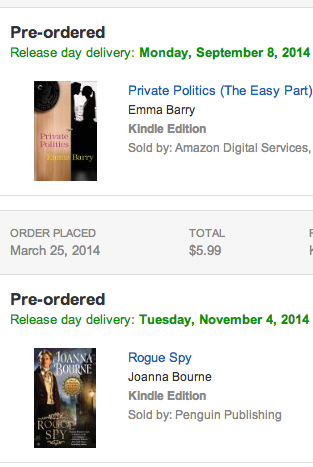
In just over four weeks, Private Politics will be out. And it shows up in my preorders along with Joanna Bourne. Tee-hee.
I’m so excited about Private Politics‘ release that I’m going to give away one digital advanced reader copy–either .mobi or .epub format. We’ll keep things simple: just comment on this post and I’ll choose the winner at midnight EST next Friday, August 8. Limit one entry per person.
Remember: cuddly, beta hero. Smart, shoe-obsessed heroine. Sleazy lobbyists. Epic hugs. And the best chili dogs in the world.
(If you’re a reviewer, don’t forget it’s on NetGalley now.)
**
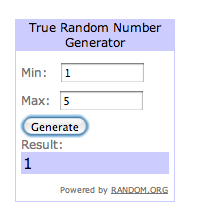
So I numbered the entrants one to five (Kimberley, Justine, Leftcoaster, Bijal, and Emily) and the Random Number Generator spit out the number one. I’ve emailed Kimberley. And I’m so glad people are excited for the book! It’ll be out in less than a month now.
Private Politics just appeared on NetGalley!
I’m really proud of this book. It’s an opposites attract romance featuring a beta blogger hero and a socialite heroine who is going through some self reevaluation. He helps her investigate a scandal at her job and hijinks ensue. There’s corruption and money laundering, an epic hug and Mahler, and the (in my opinion) best first kiss I’ve written yet.
If you blog about or review contemporary romance and are interested in featuring or reviewing the book, doing an interview with me, running an excerpt, etc., please send me an email–author.emma.barry (at) gmail.com–and we’ll see if we can work something out. I’m limited in how many copies I can give out, but if you have a problem with your NetGalley request, or if you don’t use NetGalley, let me know.
For more information about the book, including the opening chapter, look here.
Hey there, cats and kittens! Private Politics will be out in just over a month. If you like beta heroes, lobbyists, heroines who are finding themselves, scandal, and Mahler, you should be very excited.
And you can read the first chapter just below the fold.
What follows is a random collection of jet-lag fueled thoughts meaning it’s even more random than normal. You’ve been warned.
Yesterday, Kaetrin wrote an essay on Dear Author about the problem of accumulation. She explores how the overrepresentation of certain kinds of people in romance shapes the genre by pushing writers toward certain tropes. There are by a factor of a thousand to one more dukes in romance than there were/are in real life, but if you’re writing, discoverability is a real issue–so do you choose to write the millionth duke romance or do you write a romance set in a Shaker community in antebellum America? Probably the duke.
(Aside: I desperately want to read a Shaker romance. Why are we so obsessed with the Amish? I mean, other than the fact that Shakers were celibate. And this leads to me asking for an asexual romance. Has anyone read either?)
It’s not an apolitical question. In the land of 10,000 dukes, lots of people are unrepresented or unrepresentable–and that matters in terms of who is being written out of history and for whose story seems to have subjectivity in the present. As Kate Sherwood pointed out in the comments, there’s a magnifying effect because readers and writers learn through their reading. They learn the tropes, thus making certain ideas de rigueur, but I think they also probably learn the worlds too.
Continue reading “Authenticity in Romance; or, The Land of 10,000 Dukes”
I’m happy today to participate in the cover reveal for Kat Latham‘s latest, Tempting the Player.

Yeah, the reason I signed up is a total mystery to me too.
Ahem. Somehow she gets the sexiest covers. Want to read the blurb and see some buy links? Or enter the giveaway? Follow me below the fold. Or you could just stay and stare at his…shoes.
 Emma Barry