When I was 19, I took a class that changed my life. A cliche, I know, but it happened. I was a freshman in college and an English major, but I’d begun studying Latin and had developed an infatuation with Roman history. Classics might have lured me away from English…if it hadn’t been for that survey of early American literature.
The truly wild part was that I went in certain that I loathed literature written in the U.S. before 1900, an opinion I’d formed based on a mere whiff of exposure. In high school, I read European literature and lots of it. Mark Twain, Nathaniel Hawthorne, Edgar Allan Poe, and Emily Dickinson were the only exceptions. But that must’ve been because those were the only good texts. After all, the cream rises to the top, right?
What brought the sky down around my ears wasn’t simply discovering that I was wrong and that many of the stories and poems, the memoirs and speeches from the early United States were electric. Seriously, Frederick Douglass and Abraham Lincoln are my favorite prose stylists, and it isn’t even all that close.
No, what made me stay in the field, what drove me to get a PhD in American studies, was how my professor taught us to read. I didn’t have this term then, but as teen, I’d been indoctrinated in New Criticism. In other words, the belief that the meaning of a work of art is intrinsic, and there’s no need look beyond the page for it. But in college, I met New Historicism and learned to read texts as products of culture. I never looked back.
I’ll spare you the gory details, but I never stopped reading American literature, and it remains the love of my intellectual life. So the last ten years…they’ve been a lot. And like a lot of academics, I’ve been watching the semiquincentennial approach with mild (and sometimes less than mild) revulsion.
But I woke up this morning wanting to read the texts that make me think about this place, about its complexities and its beauties and its messiness and its potential. The texts that represent the last 250 years, and the ones that make me anticipate the future.
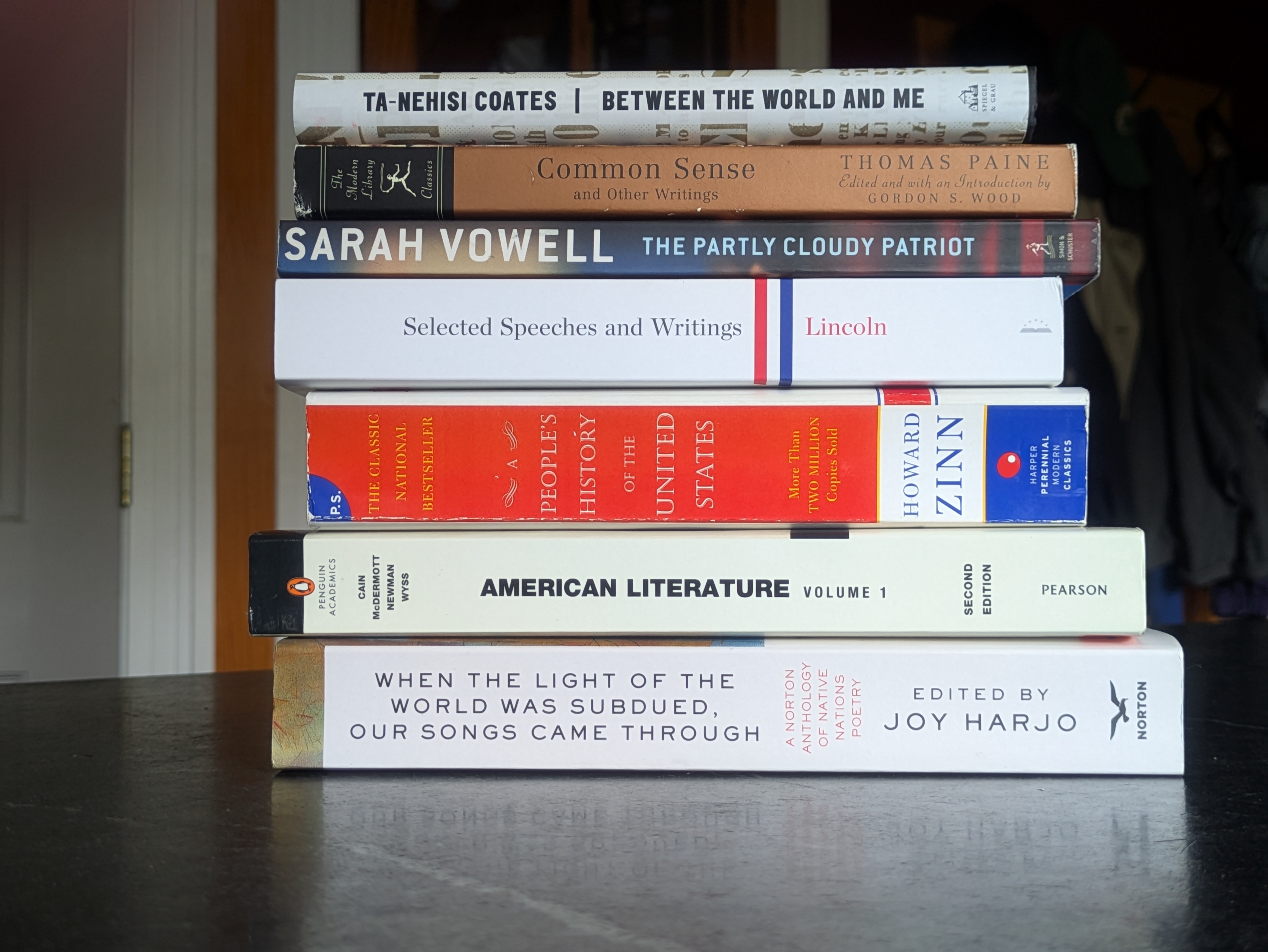
In no particular order, here’s my semiquincentennial reading list:
- Between the World and Me, Ta-Nehisi Coates: “that this is your country, that this is your world, that this is your body, and you must find a way to live within the all of it” (11-12).
- Common Sense and Other Writings, Thomas Paine: “These are the times that try men’s souls: The summer soldier and the sunshine patriot will, in this crisis, shrink from the love and thanks of man and woman. Tyranny, like hell, is not easily conquered; yet we have this consolation with us, that the harder the conflict, the more glorious the triumph” (83).
- I Love America. That’s Why I Have to Tell the Truth About It, Viet Thanh Nguyen: “So it is that every day I ask my son if he has eaten yet and every day I tell my son I love him. This is how love of country and love of family do not differ. I want to create a family where I will never say ‘love it or leave it’ to my son, just as I want a country that will never say the same to anyone.”
- Nobel Prize lecture, Toni Morrison: “It is the deference that moves her, that recognition that language can never live up to life once and for all. Nor should it. Language can never ‘pin down’ slavery, genocide, war. Nor should it yearn for the arrogance to be able to do so. Its force, its felicity is in its reach toward the ineffable.”
- The Partly Cloudy Patriot, Sarah Vowell: “Jack and I put our hands over our hearts and sang that song loud. Because we love our country too. Because we wouldn’t have been standing there, wouldn’t have driven down to Washington just to burst into tears if didn’t care so very, very much about how this country is run” (169).
- A People’s History of the United States, Howard Zinn: “As we pass from one century to another, one millennium to another, we would like to think that history itself is transformed as dramatically as the calendar. However, it rushes on, as it always did, with the forces racing toward the future, one splendidly uninformed, the other ragged but inspired” (687).
- Selected Speeches and Writings, Abraham Lincoln: “Passion has helped us; but can do so no more. It will in future be our enemy. Reason, cold, calculating, unimpassioned reason, must furnish all the materials for our future support and defence” (21).
- Speech on the Dred Scott Decision, Frederick Douglass: “[A]ll I ask of the American people is, that they live up to the Constitution, adopt its principles, imbibe its spirit, and enforce its provisions. When this is done, the wounds of my bleeding people will be healed, the chain will no longer rust on their ankles, their backs will no longer be torn by the bloody lash, and liberty, the glorious birthright of our common humanity, will become the inheritance of all the inhabitants of this highly favored country.”
- “The Red Man’s America,” Zitkala-Sa: “My country! ’tis to thee,/Sweet land of Liberty,/My pleas I bring./Land where OUR fathers died,/Whose offspring are denied/The Franchise given wide,/Hark, while I sing.”

